

Roaming at EV charging stations: what it gives operators and when it makes sense

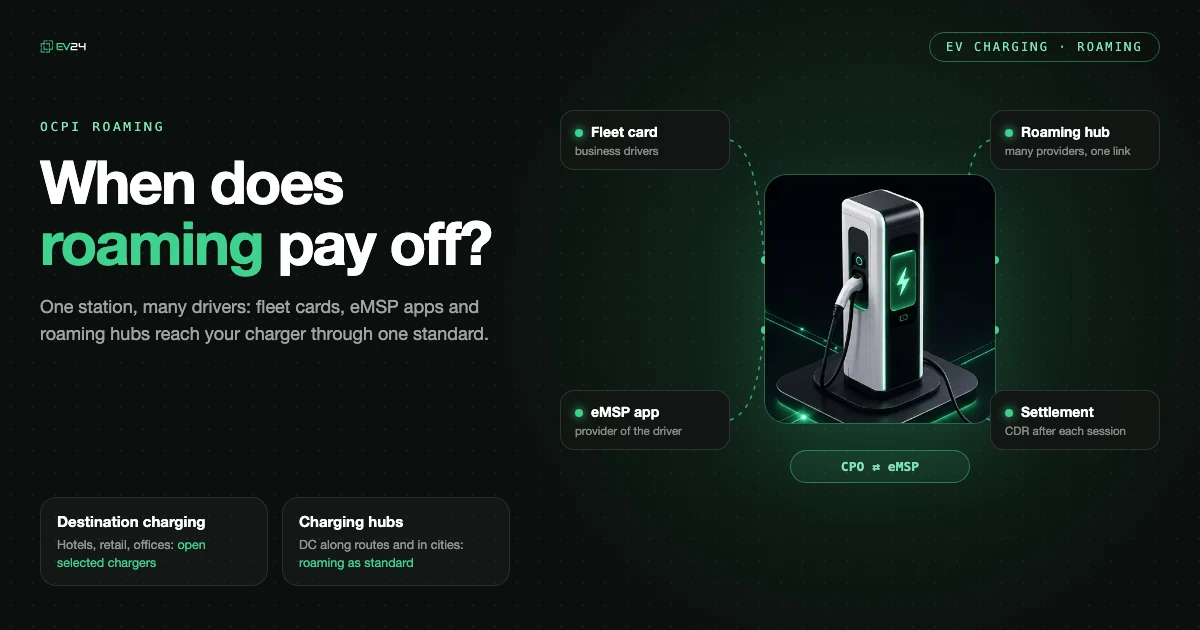
A driver pulls up to your station. They carry a fleet card from their employer or the app of a charging service provider they use all over Europe. They do not want to install another app or create another account. They want to tap a card, charge the car and drive on.
Can that driver charge at your station? It depends on whether your station is available in roaming.
Roaming is often presented as something every station "must have". That is a simplification. For some locations roaming is the main source of sessions; for others it brings little beyond extra costs and questions from drivers. In this article we explain what roaming is, how it works in practice, what it costs and how to judge whether it makes sense in your case: at a hotel car park, next to a shop, at an office or in a fast-charging hub along a route.
What roaming at charging stations is
Roaming lets a driver charge at one operator's station with the card or app of another company. The charging market has two roles:
- The CPO (Charge Point Operator) runs the stations. It is responsible for the chargers, their availability, prices and the quality of location data.
- The eMSP (e-Mobility Service Provider) serves drivers: it issues cards and apps, owns the relationship with the driver and bills them. A provider can be a fleet card issuer, a car maker, an energy company or an independent app.
Roaming connects the two. The driver is a customer of the eMSP but charges at the CPO's station. The driver pays their provider, and the provider settles with the station operator.
The connection can be direct (peer-to-peer: one operator, one provider, a separate agreement and integration) or go through a roaming hub, a platform that connects many operators with many providers. One connection to a hub opens the stations to customers of every provider connected to it, as long as both sides agree to work together.
| Model | Advantages | Disadvantages |
|---|---|---|
| Peer-to-peer | A direct relationship and terms negotiated with one partner, no intermediary. | Every partner means a separate agreement, integration and settlement. |
| Roaming hub | One connection, access to many providers, common settlement rules. | Hub fees, less influence on terms with a single provider. |
How a roaming session works
Technically, roaming usually relies on the OCPI standard (Open Charge Point Interface). The OCPP protocol connects the station with the management system (CSMS), and OCPI connects the management system with roaming partners. A single session goes like this:
- Publishing locations and tariffs. The operator shares data about locations, charge points, statuses and prices with partners. This is how the station appears in the provider's app.
- Authorization. The driver taps a card or starts charging in the app. The operator's system checks the driver's token, either against a token list shared earlier by the provider or by asking the provider in real time.
- Session. Charging runs like any other. The provider can receive session data as it happens, and the driver sees it in their app.
- Charge detail record (CDR). When charging ends, a CDR is created: energy, time and price according to the operator's tariff.
- Settlement. Based on the CDRs, the operator settles with the provider, usually monthly. The provider bills the driver according to its own price list.
That last point surprises many operators: in roaming you do not set the price the driver sees. The price at which the provider buys the session comes from a roaming tariff agreed with the partner, either by the operator itself or, more often, by its platform. The provider may add a margin, offer a subscription or, on the contrary, sell the session cheaper as part of a fleet package.
What roaming gives an operator
- Drivers you would not reach otherwise. Fleet drivers often may only charge with a company card, because that is how costs are booked. Without roaming your station simply does not exist for them.
- Visibility in provider apps. A location published in roaming appears on the maps drivers use to plan charging. For a station along a route this often matters more than the payment itself.
- Drivers from abroad. A driver from another country usually uses the app or card of their own provider. Roaming lets them charge without creating a local account.
- Better station utilization. Every additional session on existing infrastructure lowers the cost per session and shortens the payback period.
- Fewer payments to handle. The provider handles billing with the driver, so the operator has one invoice with the partner instead of many small transactions.
Costs and limits of roaming
Roaming is neither free nor maintenance-free. Before switching it on, it is worth knowing its weaker sides:
- Fees and commissions. Roaming hubs and some providers charge for the connection, per session or a percentage of the transaction. The roaming tariff should take them into account; otherwise each roaming session earns less than an ad-hoc payment.
- Delayed settlement. Money from a card payment reaches the operator right away. Money from roaming arrives after the settlement cycle, often several weeks later.
- No control over the driver's price. If the provider adds a high margin, the driver will think your station is expensive. Complaints and reviews go to the location, not to the app.
- Data requirements. Partners expect up-to-date statuses, opening hours, prices and access details. A station shown as "available" in the app that actually sits behind a barrier collects bad reviews quickly.
- Less direct customer relationship. A roaming driver is the provider's customer. You do not have their data, cannot send them an offer and cannot build a loyalty programme around them.
- Roaming does not replace ad-hoc payment. At public stations, the AFIR regulation requires a way to pay without a contract with a provider, for example by payment card. Roaming complements ad-hoc payment; it is not an alternative. Read more in our article on AFIR and EV charging stations.
Roaming in destination charging
Destination charging means charging at a place the driver visits anyway and stays at for a longer time: a hotel, restaurant, shopping centre, sports venue, office or a car park at a tourist attraction. AC chargers of 11–22 kW dominate, and the length of the stay depends on the purpose of the visit, not on the need to charge the battery.
A driver at a destination rarely looks for a station "blind". They choose the hotel or restaurant, and the charger is an extra. That is why roaming matters selectively here.
Roaming makes sense when:
- the station is publicly accessible and the car park is open to people who are not guests,
- the venue receives business guests and fleet drivers, for example a hotel along a route or a conference centre,
- many drivers from abroad stay in the area (tourism, border towns),
- the chargers stand idle for much of the day and every additional session improves utilization.
Roaming makes little sense when:
- the stations serve only employees, residents or your own fleet,
- charging is a free benefit for guests (roaming assumes selling the session, not giving it away),
- there are few stations and regular users occupy them at peak times,
- access to the car park requires a pass, a hotel key card or a barrier that a driver with an app cannot open.
In destination charging a mixed approach works best: roaming enabled only for selected stations. For example, two chargers at the entrance are open to everyone, including roaming drivers, while the others serve hotel guests through PIN or RFID. How to open a station to outside drivers is described in our article how to make an EV charging station public, and the hotel scenario in the text on the hotel EV charging station.
Roaming at charging hubs
A charging hub is a location built for charging itself: several or a dozen fast DC chargers along a motorway, at a fuel station, at a logistics node or in the city. The driver comes here to charge the car and wants to do it quickly.
At hubs, roaming is usually the basis of the business model, not an extra:
- Fleet drivers (company cars, vans and increasingly trucks) plan routes in their providers' apps and charge where their card works.
- Drivers on the road pick a station from the map in an app or in the navigation system. A hub that is not visible in popular apps loses traffic to a competitor a few kilometres away.
- A hub's profitability depends on utilization. Fast DC chargers are expensive, and paying them back takes many sessions per day. Roaming is one of the most effective ways to increase the number of sessions.
At hubs, details matter: a roaming tariff that covers partner fees, idle fees after charging ends, accurate real-time connector statuses and information about access for vans and trucks.
Destination charging and hubs compared
| Criterion | Destination charging | Charging hub |
|---|---|---|
| Typical chargers | AC 11–22 kW, sometimes a single DC | DC 50–400 kW |
| Reason for the visit | Hotel, shopping, work, leisure | Charging itself |
| Who charges | Mostly guests and regular users of the venue | Drivers on the road, fleets, drivers from abroad |
| Role of roaming | A complement: worth it for selected, public stations | A basis: a large share of sessions comes from partner cards and apps |
| Recommended scope | Single stations | The whole location |
When roaming does not make sense
Roaming is not a good idea when:
- the station is private or meant for a closed group (employees, residents, a fleet),
- you do not want to or cannot provide up-to-date availability and price data,
- the margin after partner fees is close to zero and the station is already well utilized,
- access to the station is physically restricted and an outside driver cannot reach the charger,
- what matters most to you is a direct customer relationship, for example in a retail chain's loyalty programme.
How to decide
- Define who should charge. If the answer is "any driver", roaming is worth considering. If it is "only our guests or employees", probably not.
- Calculate the margin after fees. Compare the revenue of an ad-hoc session with the revenue of a roaming session after commissions. Choose a roaming tariff that pays off for you.
- Choose the scope. At a hub usually the whole location; at a destination, selected stations.
- Take care of the data. Check opening hours, directions, barrier information and how current the statuses are.
- Measure the result. After a few months, check the share of roaming sessions, their revenue and the number of driver requests. Then extend or limit roaming.
How it works in EV24®
In EV24®, roaming is an option the operator switches on, not a default setting. It can be enabled with one switch for a whole location (typical for hubs) or for a single charging station (typical for destination charging). Switching it off is just as easy.
EV24® negotiates roaming prices with the partners. The operator does not have to agree terms with every provider separately, but chooses one of the roaming tariffs provided by EV24® for its stations. You can find the current prices on the roaming tariffs page.
Outside roaming, payment methods and invoicing of drivers who pay ad hoc stay with the operator. Roaming works alongside ad-hoc payment (card, Apple Pay, Google Pay, BLIK, TWINT, payment terminal) and RFID and PIN authorization.
The platform will work with many roaming partners. Currently these are:
- DKV, an issuer of fleet cards and mobility services for transport companies and fleets,
- e-clearing, a roaming hub that connects many operators and charging service providers across Europe.
How to enable roaming, who we work with and how sessions are settled is described on the roaming services page. Read more about the platform for operators on the charging point operator page.
Summary
Roaming lets drivers of other providers charge at your station with the card or app they already have. It gives the most where the driver picks a station from a map and comes to charge the car: at fast-charging hubs and along routes. In destination charging it is rather a complement for selected, public stations. It makes no sense at private stations, with free charging for guests, or where the margin disappears after partner fees.
It is worth basing the decision on three questions: who should charge at the station, how much is left from a session after fees, and whether the station data is good enough for a driver with an app to use the station without problems.
FAQ
What is roaming at a charging station?+
It lets a driver charge at one operator's station with the card or app of another company, an e mobility service provider (eMSP). The driver pays their provider, and the provider settles with the operator based on charge detail records, usually using the OCPI standard.
Who sets the charging price in roaming?+
The price for the provider comes from a roaming tariff agreed with the partner. In EV24®, EV24® negotiates the tariffs and the operator chooses one of them, listed on the roaming tariffs page. The driver's provider sets the price for the driver: it may add a margin, offer a subscription or a fleet package. That is why the price in the driver's app may differ from the ad hoc price at the station.
Does roaming pay off at a hotel or a shop?+
Usually for selected, publicly accessible stations, especially when the venue receives business guests, fleet drivers or tourists from abroad. It makes no sense when charging is free for guests or the stations serve only employees and residents.
Why is roaming important at charging hubs?+
Drivers on the road and fleet drivers choose stations in their providers' apps and charge where their card works. A hub that is not visible in roaming loses them to competitors, and the profitability of fast DC chargers depends on the number of sessions.
Does roaming replace card payment at the station?+
No. Public stations need ad hoc payment without a contract with a provider, for example by payment card, as required by AFIR. Roaming is an additional way for providers' customers to access the station.
How do I enable roaming in EV24®?+
In the operator portal, roaming is enabled with one switch for a whole location or for a single station. EV24®'s current roaming partners are DKV and e clearing.