

How to make an EV charging station public and commercialize it

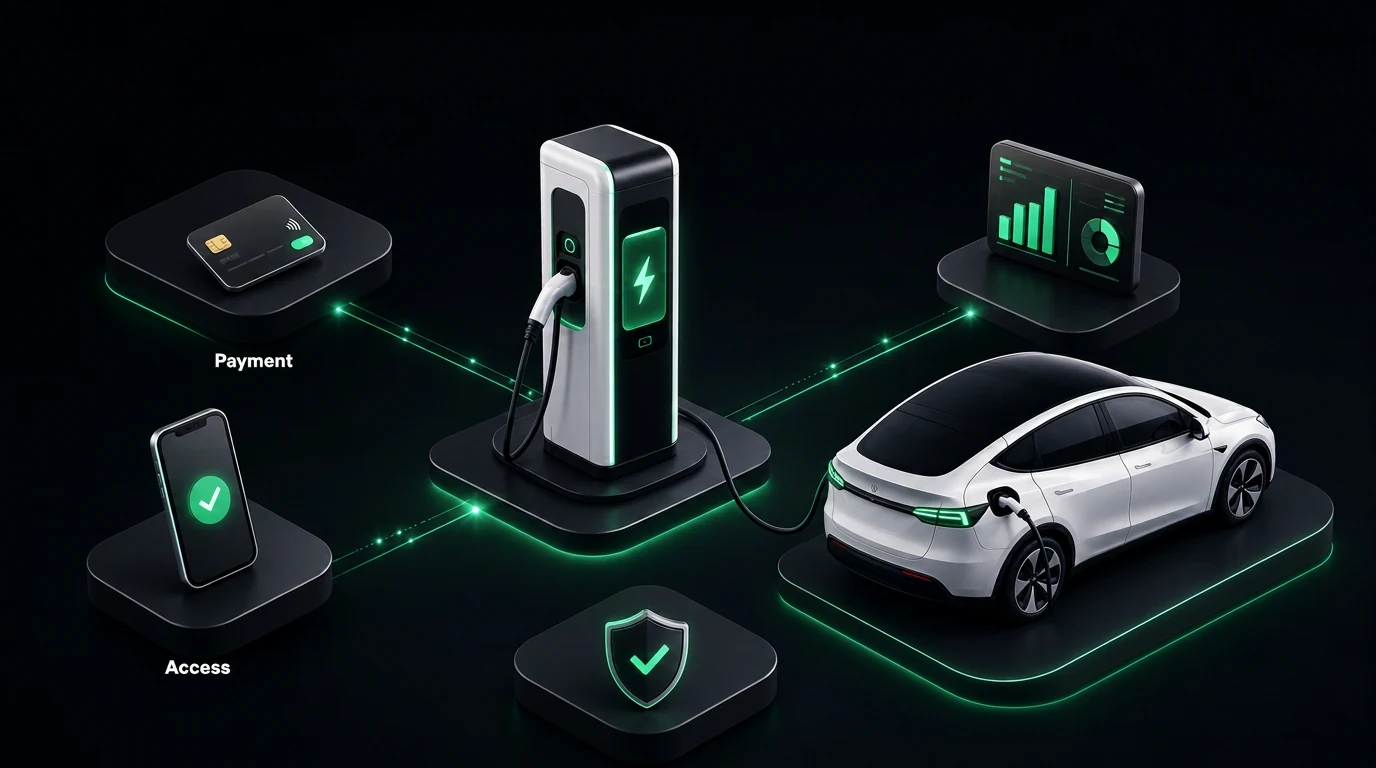
Do you already have an EV charging station at your company, hotel, car park, office, restaurant, showroom or service location and want to make it available to external drivers? This is a common moment in the development of EV infrastructure. A charger is often installed first for internal use: fleet vehicles, employees, tenants, guests or customers. After a few months, the next question appears: if the device is already there, has available power and can charge electric vehicles, can it generate revenue or at least recover electricity costs?
The short answer is yes, but the charger alone is not enough.
Making an EV charging station public is not just a sign saying “charging available”. It is a process covering driver authorization, pricing, payment, invoicing, refunds, customer support, monitoring, fault handling, compliance and clear responsibility for the charging service. In practice, many companies have charging hardware, but they do not yet have a complete charging service.
This guide is for infrastructure owners who want to understand:
- how to make an EV charging station publicly available,
- when a private charger becomes a public charging point,
- how to commercialize an EV charging station and charge users,
- whether a charge point operator is needed,
- how to launch EV charging payments,
- how to settle employee, fleet or tenant charging,
- who issues invoices and handles complaints,
- how to prepare pricing,
- how to avoid chaos around failed sessions, refunds and driver support,
- how to let drivers start charging without mandatory registration or app installation.
This is not another article about ROI and margin. We cover that separately in how to earn from an EV charging station. Here we focus on the operating path: how to turn a charger into a working commercial charging service.
A charging station is hardware. Public charging is a service.
The most common mistake is assuming that if the station works technically, it can simply be opened to drivers. From the driver’s perspective, the device is only one part of the experience. What matters is the full process.
The driver wants to know:
- whether the charger is available,
- how much charging costs,
- how to start a session,
- whether an app is required,
- whether payment is possible by card, wallet, QR or another method,
- whether an invoice is available,
- what happens if payment is authorized but charging does not start,
- who to contact if the station is offline,
- whether the price is clear before charging begins.
The site owner has another set of questions:
- who manages pricing,
- who receives payment,
- who settles energy,
- how employee, fleet or customer charging is separated,
- who issues accounting documents,
- who handles refunds,
- who sees station status,
- who responds to faults,
- who communicates with the driver,
- who prepares reports,
- who controls charging access.
Commercializing a charging station is therefore not only about adding a QR code or a payment terminal. It is about creating a repeatable operating model.
Who is this model for?
Public or semi-public EV charging makes sense in many locations. It is not only for large fast-charging networks on highways. The biggest opportunity often lies in places where drivers already leave their cars for some time.
Typical examples include:
- hotels, guesthouses and apartments,
- restaurants, cafes and service locations,
- shops, showrooms and retail parks,
- office buildings and business parks,
- paid car parks,
- workshops, car washes and automotive services,
- shopping centres,
- sports facilities, spas and conference centres,
- housing communities with guest parking,
- companies that already have chargers for fleets but also want to settle employee charging or open stations after business hours.
In each place the charger has a different business role. For a hotel, it improves the standard of the stay. For a car park, it can be a direct revenue stream. For a restaurant, it may extend the visit. For an office building, it improves tenant value. For a fleet operator, it can separate employee, company and external charging in one system.
Private, semi-public and public charging station
The practical question is not only whether the charger is “private” or “public”. The key issue is who can use it and under what rules.
A private charging station is used by a closed group: fleet vehicles, employees, residents or selected users. Access is usually controlled by account, RFID, eTag, PIN, user list or a physical barrier.
A semi-public charging station is available to a defined group: hotel guests, office tenants, restaurant customers, showroom visitors or employees. Access can depend on a code, reception process, pricing rules or another service.
A public charging station is available to a broader group of drivers. The user should be able to see the price, start charging and pay in a clear way. In this model, price transparency, ad hoc payment, visibility, support and compliance become much more important.
| Model | Who uses it | Typical access | Main risk |
|---|---|---|---|
| Private charging station | Fleet, employees, residents, selected users | Account, RFID, eTag, PIN, closed parking | No user-level settlement, abuse, unclear access rules |
| Semi-public charging station | Customers, guests, tenants, site users | QR, PIN, reception, app, card | Unclear rules, missing limits, unclear pricing |
| Public charging station | Any eligible driver | Ad hoc payment, QR, app, terminal, roaming | No support, invoice issues, complaints, information obligations |
Many companies do not need to start with a fully public model. A semi-public launch for guests, customers or tenants is often the best first step. It is easier to operate and gives real data before wider publication.
What commercialization actually means
Commercializing a charging station means that the infrastructure starts working as part of a business model. It does not always mean maximizing margin on every kWh. There are three common strategies.
The first strategy is cost recovery. The company does not want aggressive profit, but it also does not want to finance electricity for external users. Pricing covers energy, distribution, payment fees and part of the operating cost.
The second strategy is additional revenue. The station is expected to generate money directly. The owner analyses utilization, sets margin, controls rotation and uses reports.
The third strategy is customer attraction. Charging may be paid, discounted for customers or available with a code. The goal is not only energy revenue, but higher value of the location.
These strategies can be combined. A hotel may offer a free limit for guests and charge above that limit. A car park may have different prices for subscribers and external users. A company may let employees charge company cars while opening chargers publicly after hours. If the driver does not pay directly at the charger, read also our guide on whether you can offer EV charging to customers free of charge.
This is where a system is needed. It must support different access rules, pricing and settlement scenarios. If you have a charging station at a company and want to use it for employees, customers and external drivers, the system must separate private charging, company charging, fleet charging and paid public sessions.
Step 1: check whether the charger is technically ready
Not every charger that works privately is immediately suitable for public use. The most important requirement is communication with a charging station management system, often called a CSMS. In practice, the standard is OCPP, which connects the charging station with the operator backend. The system can then see the device status, start and stop sessions, read energy data, manage connectors, register faults and assign charging to a user.
Before launch, check:
- whether the station supports OCPP 1.6J or newer,
- whether the internet connection is stable,
- whether all connectors are visible in the system,
- whether remote start and stop work correctly,
- whether energy values are reported as expected,
- whether the station recovers after restart,
- whether firmware is up to date,
- whether manufacturer support is available,
- whether the site has sufficient grid capacity,
- whether load management is required.
If you are still selecting hardware, read how to choose an EV charging station. For public use, integration quality and serviceability matter as much as the hardware price.
Step 2: decide who operates the charging station
The infrastructure owner and the charge point operator are not always the same role. The owner owns the device, the location and often the electricity cost. The operator is responsible for the service: availability, configuration, pricing, monitoring, driver support, settlement and response to issues.
A good charging station operator should provide:
- station onboarding into the system,
- connector and tariff configuration,
- online monitoring,
- driver authorization,
- payments,
- sales documents,
- owner reports,
- support process,
- refunds and complaint handling,
- communication during faults,
- support for network expansion.
For more detail, read what an EV charging operator is responsible for when something breaks. Public charging without operational ownership quickly becomes a source of frustration.
Step 3: choose the charging access model
The access model determines how the driver starts a charging session.
QR code is the simplest model for occasional users. The driver scans the code, sees the price, selects the connector, pays and starts charging. It does not require prior registration or app installation.
An app works well for returning users, larger networks, session history, company accounts and favourite locations. It is useful, but it should not be the only path for a first-time driver.
RFID cards work well for fleets, employees, tenants and closed user groups. eTag or NFC can be used to securely separate employee, guest, customer and fleet charging. PINs are practical for hotels, receptions, restaurants and parking sites because they can be one-time, time-limited or kWh-limited.
| Access method | Best use case | Advantage | Limitation |
|---|---|---|---|
| QR code | Public drivers, guests, occasional users | Fast start without app or registration | Requires a clear payment flow |
| App | Returning users and charging networks | Account, history and convenience | Can be a barrier for the first session |
| RFID or card | Fleets, tenants, employees | Simple authorization for known users | Identifiers must be issued and managed |
| eTag or NFC | Locations with multiple access groups | Secure separation of users and scenarios | Requires process design |
| PIN | Hotels, receptions, restaurants, promotions | Can be one-time, time-limited or kWh-limited | Rules for issuing codes are needed |
EV24® can combine access models depending on location and user type. One station can support public charging, employee charging, fleet charging and guest access without mixing settlements. The driver-side process is described in the EV24® charging app.
Step 4: prepare pricing drivers can understand
Pricing is not just a number per kWh. It must be clear before charging starts and it must protect the owner from selling below cost.
Common pricing elements include:
- price per kWh,
- start fee,
- fee after charging is finished,
- parking or occupation fee,
- free time or energy limit for customers,
- different prices for different user groups,
- different AC and DC prices,
- discounts for tenants or guests.
For smaller locations, start simple. The driver should see a clear kWh price and, if needed, information about an idle fee. Too much complexity increases questions and complaints.
For larger locations, dynamic EV charging pricing may make sense. Prices can depend on demand, time of day, energy cost or the business goal of the site.
Step 5: launch convenient payments for drivers
If the station is public, payment must be simple. The driver should not have to download an app, create an account, wait for an RFID card or call reception.
A good model is payment through a landing page after scanning a QR code. The driver sees the charger, connector and price, then pays online. Depending on the market and provider, this can be card payment, mobile wallet or another local payment method.
In some locations, a payment terminal is required or recommended, especially where public ad hoc payment requirements apply. This is discussed in payment terminals for EV charging and AFIR.
The key point is that the payment must be linked to the charging session. The system should know who paid, for which station, for which connector, at what price, whether the session started, how much energy was delivered, whether a refund is needed and whether an invoice should be issued.
Step 6: organize invoices and accounting
Commercial charging quickly reaches accounting. If you charge users, you must know who sells the service, who receives payment, who issues documents and how settlement is reported.
Important questions:
- who is the seller of the charging service,
- who receives payment,
- who issues the invoice,
- who handles corrections,
- who handles refunds,
- how commissions are booked,
- how the infrastructure owner receives funds,
- how sessions are reported,
- whether session data is sufficient for accounting.
The broader topic is covered in EV charging station billing. For a public station, invoicing cannot be an occasional manual task. It must be part of the designed process.
Step 7: prepare station signage and a simple instruction
The station owner should not have to write the whole user process from scratch. This is one reason to use a charging service provider. In a well-prepared implementation, the QR landing page, price information, operator details, payment flow, charging instruction, support contact and settlement rules are part of the service.
The owner mainly decides who can use the station, whether charging is public or customer-only, what the price is, whether limits apply and whether the station is available 24/7. Based on this, the provider prepares the user communication and station marking.
In practice, the driver needs to know three things on site: how to start charging, how much it costs and where to report a problem.
Step 8: make sure the operator handles monitoring and issues
For public charging, the site owner should not manually diagnose every issue. The key is to ensure that someone actually sees station status, payments, sessions and user reports.
We cover this in detail in what an EV charging operator is responsible for when something breaks. The main rule is simple: if the station is public, there must be clear responsibility for offline status, failed session start, refunds, invoices, pricing issues and driver reports.
In the EV24® model, monitoring, session statuses, payments and user support data are part of the system, so the infrastructure owner does not become a manual support centre for every session.
Step 9: decide whether the station should be publicly visible
If you want external drivers to use the charger, they must be able to find it. Visibility may mean an operator app, charging directory, map, roaming system or the site’s own website.
Do not publish every station broadly from day one. If the location has limited opening hours, a barrier, few parking spaces or requires reception confirmation, this must be communicated clearly. Public visibility without real access creates a poor driver experience.
For many sites, a staged launch works best: first semi-public access for guests or customers, then wider publication, then pricing and utilization optimization.
Step 10: calculate the whole process, not only electricity
Owners often start with “what should the kWh price be?”. That matters, but it is not enough.
Calculate the full process:
- energy cost,
- distribution cost,
- grid or connection cost,
- payment fees,
- operator system cost,
- service cost,
- accounting cost,
- support and complaint handling,
- station depreciation,
- downtime risk,
- parking space value,
- signage and communication,
- marketing value for the location.
Only then can you decide whether the station should generate direct profit, support another service or improve the site’s standard.
Step 11: sign the service agreement and define responsibility
A public or semi-public charging station needs more than technical configuration. It also needs an agreement with the provider delivering the system, payments, settlement, user access or the full operator service.
The owner should clarify:
- who is the charge point operator,
- who sells the charging service to the driver,
- who receives payments,
- who pays out funds to the infrastructure owner,
- who issues invoices,
- who handles refunds and complaints,
- who monitors station status,
- who communicates with the end user,
- who escalates hardware faults,
- what reports the owner receives,
- what the system costs and payment terms are.
An EV24® implementation usually starts with station, location and business model data. Then the technical OCPP integration is checked. Next, locations, connectors, tariffs, access methods and payments are configured. Settlement data, payout rules, invoicing, driver communication and support scope are agreed in parallel.
In the EV24® model, the owner can launch the station as a subscription service, use ready payment and settlement processes and later extend the model toward branding or white label if needed.
Common mistakes
The most common mistakes are lack of process owner, forcing app installation for first-time users, unclear pricing, no refund procedure, no monitoring, treating invoices as exceptions, no limits in promotional charging and publishing a station before the location is ready.
Each of these mistakes leads to the same result: the charger exists, but the service is not reliable.
How EV24® helps commercialize EV charging stations
EV24® is built for infrastructure owners and operators who want to turn chargers into a working service. It connects station hardware, users, payments, pricing, invoices, monitoring and reporting.
EV24® can support:
- public, semi-public and private stations,
- OCPP integration,
- QR-based session start,
- online payments,
- driver app,
- RFID, eTag, NFC and PIN access,
- pricing for different locations and groups,
- session settlement,
- owner reports,
- station status monitoring,
- operator support,
- white label models for companies building their own charging brand.
If a company wants to build its own charging brand, see also white label EV charging.
Checklist before public launch
| Area | Control question | Why it matters |
|---|---|---|
| Technology | Does the station communicate reliably through OCPP? | Without it, monitoring, session start and settlement are unreliable |
| Access | Does the driver know how to start charging? | Unclear start flow reduces utilization |
| Pricing | Is the price visible before charging starts? | Transparent pricing reduces complaints |
| Payments | Is payment linked to the session? | This is the basis for refunds, complaints and reporting |
| Invoices | Is it clear who issues the document and how the user receives it? | Manual invoicing quickly overloads support |
Summary
Making an EV charging station public is not just a technical decision. It is an operating, accounting, legal, sales and reputation decision.
If you have a charging station and want to commercialize it, start with the user model: who should charge and under what rules? Then choose authorization, payment, pricing, invoicing and public visibility.
EV24® helps companies, hotels, car parks, operators and site owners move from simply owning chargers to running a public or semi-public charging service. To see the operating layer, visit EV24® charging point operator. If you manage more devices, the next step is a charging station management system.
FAQ
How do I make an EV charging station public?+
Connect it to a CSMS, define access, pricing, payments, invoicing, monitoring and support. A charger alone is not enough because public charging is a service.
Can a private charging station be commercialized?+
Yes, if it can be integrated with an operator system, communicates reliably and has clear access, payment and settlement rules.
Do I need a charge point operator?+
In practice yes, if the station should handle payments, invoices, refunds, monitoring and public users. The operator may be the owner or a specialized provider.
Does the driver need an app?+
Not necessarily. QR, ad hoc payment, PIN or another simple method can be enough. An app is useful for returning users, but should not be the only path.
Who issues the invoice?+
It depends on the business model. It may be the station owner, operator or charging service provider. The model should be defined before launch.