

Can you offer EV charging to customers free of charge?

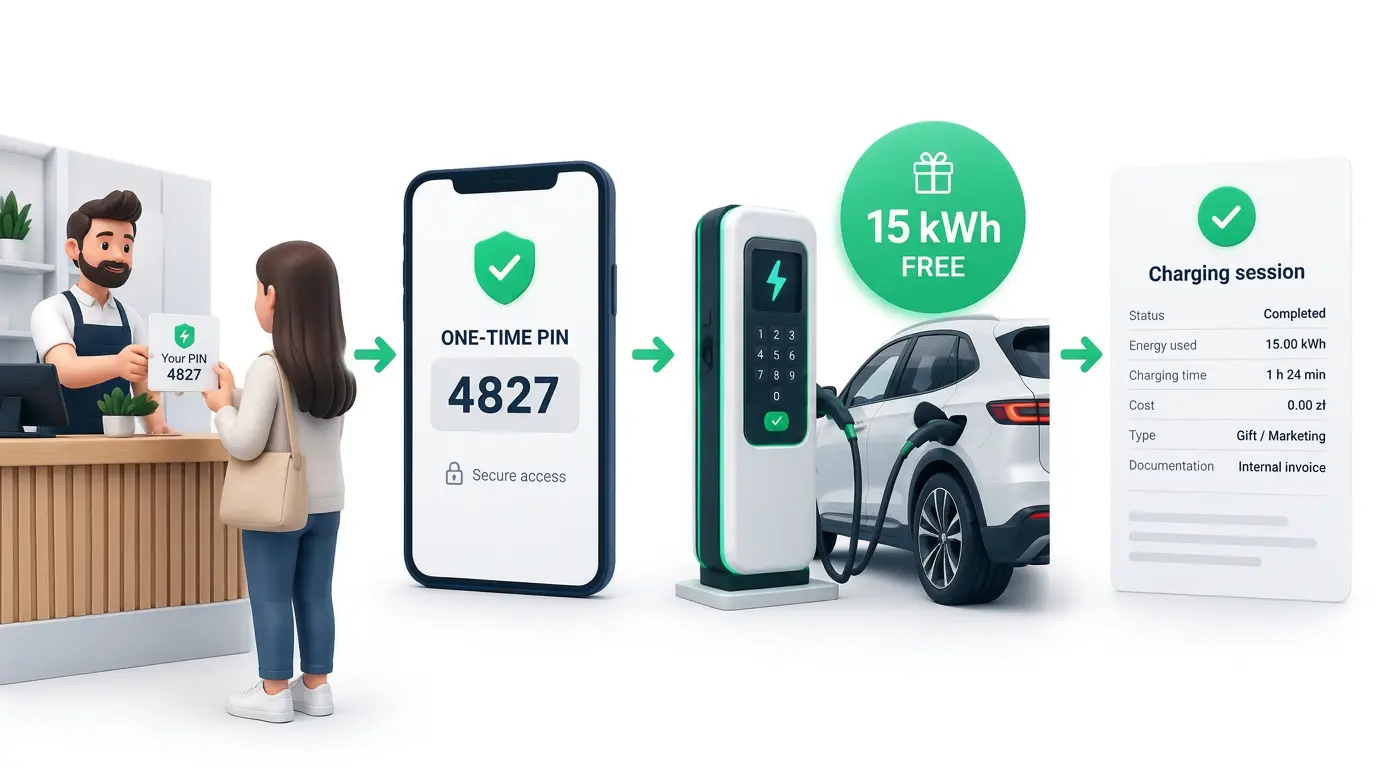
The short answer is: yes, in many cases a company can let customers, hotel guests, tenants or employees charge an electric vehicle without paying at the charger. But it should not be treated as uncontrolled energy giveaway.
From a tax and compliance perspective, free EV charging is safer when the company can show a clear business purpose: sales support, customer service, marketing, hospitality standard, fleet operations or workplace organisation. If that link is missing, the free use of the charger may become a taxable non-cash or non-paid service, depending on the local VAT rules and the specific structure.
This article explains how to design free EV charging as a controlled service, not as an informal parking-lot favour. It focuses on practical decision-making for companies operating in Poland and the EU, with references to Polish VAT logic, e-mobility regulation, AFIR, invoicing, customer communication and operator responsibilities.
It is not legal or tax advice. Before launching a specific model, the structure should be reviewed with a tax adviser or lawyer familiar with e-mobility. The goal here is to show the questions a company should answer before telling customers: “you can charge here free of charge”.
The key rule: free charging must have a business purpose
Free EV charging can be a valuable business tool. It can encourage customers to stay longer, improve a hotel’s standard, strengthen a car dealership offer, improve the image of an office building, make a retail location more attractive or support employees during the transition to electric mobility.
But from a VAT perspective the key question is not whether the driver pays at the charger. The key question is why the company provides the service and whether it is connected to its business activity.
If free charging supports sales, customer service, marketing or the main service, the company has a stronger argument that the benefit serves its business. If the company finances electricity for third parties or employees for private purposes without a business link, the tax risk increases.
The first question is therefore not: “Can we make charging free?”. The first question is: “What business purpose does free charging serve, and how do we document it?”.
What “free charging” really means
In everyday language, free charging simply means that the driver does not pay at the charger. For a company, that is not enough. Several models are possible:
- charging included in another paid service, for example a hotel stay,
- charging as a promotion for customers after a purchase,
- charging limited to tenants, employees or visitors,
- charging for a company fleet,
- charging open to everyone, without a direct payment.
Each model may feel free to the user, but each model has different tax, documentation, access-control and operational implications.
| Model | How the user sees it | What the company must define | Main risk |
|---|---|---|---|
| Hotel guest charging | Part of the stay or service standard | Whether charging is included in the room price and whether limits apply | Weak documentation that charging is part of the hotel service |
| Retail or restaurant customer charging | A customer benefit or promotion | Who is eligible, how long they can charge and how access is authorised | Use by people who are not customers |
| Charging for everyone | A public service without payment | Whether the point is publicly accessible and how the business purpose is documented | Highest tax and operational risk if there is no control |
| Employee charging | A benefit or workplace tool | Whether it applies to company cars, private cars or both | Private-use benefit and payroll/tax questions |
| Fleet charging | An internal company process | How sessions are assigned to vehicles, drivers and cost centres | Missing cost data and weak settlement records |
Private, customer-only or publicly accessible
The most important distinction is between internal charging and charging made available to external users.
If a charger is used only by a company fleet, located behind a gate and available only to authorised drivers, the main challenge is process design: access control, reporting, cost allocation, safety and maintenance.
If customers, guests or tenants can use the charger, the company enters a user-facing service relationship. Even if the user does not pay, they may expect clear rules, instructions, availability information, limits and support.
If the charger is available to an undefined group of users, risk grows. A private car park may still be used by customers. A hotel, restaurant, office building or shopping centre may be privately owned, but the charging service can still be functionally available to external users.
Polish and EU legal context
In Poland, the main e-mobility reference point is the Act on Electromobility and Alternative Fuels. It structures key concepts such as charging stations, charging points, operators, service providers and infrastructure.
Technical safety and operation should also be assessed in light of the requirements and information published by the Polish Office of Technical Inspection. UDT provides information on e-mobility infrastructure, and the installation of a charger does not end the owner’s responsibility for the device.
At EU level, AFIR Regulation 2023/1804 matters especially for publicly accessible charging infrastructure. AFIR focuses on transparency, ad hoc access, payment options and user information. If a charger is free today but may become paid later, it is worth designing the process from the beginning in a way that can support transparent prices, simple access and payment flows.
VAT: why “free” may still create tax consequences
For tax purposes the key question is: why does the company provide charging without payment?
Under Polish VAT logic, not every free service has the same consequences. But non-paid services may be treated similarly to paid services when they are provided for personal purposes or for purposes other than the taxpayer’s business activity. The reference point is the Polish VAT Act, in particular the rules around non-paid services.
In practice:
- if charging supports sales, customer service, marketing or the standard of a paid service, it is easier to show a business connection,
- if charging serves private purposes of employees, owners or unrelated third parties, the risk increases,
- if charging is part of another paid service, the company must determine whether it is ancillary, promotional, included in the price or a separate service.
A hotel can often explain charging as part of the guest experience. A restaurant can structure it as a promotion linked to a purchase. A company that simply opens a charger to everyone without a purchase, limit or user group has a much weaker position.
The safest models are usually those where free charging is:
- limited to a clearly defined group,
- linked to a stay, purchase, service, lease, employment or business relationship,
- limited by time or kWh,
- described in rules or terms of use,
- recorded in a system,
- possible to justify as a business cost.
The riskiest models are those where a company provides energy to everyone, without limits, without data and without a clear business purpose.
Invoicing and documentation
If the user does not pay for charging, there is usually no standard sales invoice for that specific session. But the absence of an invoice does not automatically mean that there are no tax consequences.
The company should distinguish three situations:
- charging is included in another business relationship, for example a hotel stay,
- charging is paid but temporarily covered by a promotion or discount,
- charging is free for one group and paid for another.
If charging may become paid later, the company should think about invoicing, corrections, customer data and accounting integration early. In Poland, the National e-Invoicing System makes this even more important because invoicing processes should not be designed at the very end of the project.
Access control: PIN codes, limits and EV24®
Free charging should not mean open and uncontrolled charging. One of the most practical models is PIN-based access.
With EV24®, a company can support free charging by generating PIN codes, including one-time PINs, visit-specific PINs or PINs limited by kWh. A hotel, restaurant, shop or office reception can give the customer a simple code, while the company keeps control over who uses the charger and how much energy can be consumed.
This is useful operationally and also helps support the tax narrative. A PIN shows that the charger was not open to everyone. It was made available to a specific group, under specific rules, with session history and limits.
For users, the experience remains simple: no mandatory mobile app, no registration, no card, just a clear charging flow. For the company, the system provides authorisation, limits, session history and reporting.
If you want to see what this looks like in practice, see the EV24® charging app and the EV24® charging station management system.
Rules and communication
The most underestimated document in free charging is the terms of use.
They should answer practical questions:
- who may use the charger,
- whether the service is truly free of charge,
- what time or kWh limit applies,
- whether authorisation is required,
- what happens if the user blocks the space after charging,
- whether the company guarantees availability,
- who supports the user in case of a problem,
- whether the promotion can be changed or ended.
Precise communication is safer than a broad slogan. “Free charging for hotel guests up to 15 kWh, subject to availability” is less catchy than “free EV charging”, but it is much clearer and more defensible.
Common abuse cases
A charger offered without payment attracts users. That is good if it is part of the plan. It becomes a problem when limits are missing.
Typical abuse cases include:
- users blocking the bay long after charging ends,
- charging by people who are not customers,
- repeated sessions by one user,
- using the charger as a permanent free energy source,
- use by external fleets,
- access outside opening hours,
- attempts to bypass authorisation.
Simple limits can solve most of these problems: one-time PINs, kWh limits, time windows, customer-only codes, reception approval, session history and separate rules for employees, customers and fleet users.
Sector examples
In hotels, free charging is often easiest to justify when it is part of the stay. The guest stays for several hours or overnight, AC charging is usually sufficient, and the cost can be treated as part of the service standard.
In restaurants and retail, rotation is higher and abuse risk is greater. A good model is to link charging to a purchase, limit it by time or kWh and use a PIN or receipt-based code.
In office buildings, different user groups need different rules: tenants, guests, employees, technical fleet and possibly public users. Without access groups and reports, cost allocation becomes unclear.
For employees, the key question is whether charging is for company vehicles or private cars. Company-car charging is a fleet process. Private-car charging may become an employee benefit and should be handled with a clear policy.
When free charging becomes paid
Many companies start with free charging and later discover that energy, service and support costs grow. At that point they want to introduce payments.
This is much easier if the system was designed properly from the beginning. A platform can add price lists, payment methods, invoices, user groups and reports. Without a platform, the company may have to rebuild the process from scratch.
That is why free charging should be designed as if it may become paid one day. Not because every company must charge for it, but because a structured model gives flexibility.
Practical checklist
Before launching charging without payment, answer these questions:
| Question | Why it matters | What to define |
|---|---|---|
| Who can use the charger? | It defines the service model and abuse risk | Customers, guests, employees, fleet, tenants or public users |
| Is it publicly accessible? | It may affect information and operational obligations | Open, restricted or internal access |
| What is the limit? | No limit increases cost and bay blocking | Time, kWh, number of sessions and opening hours |
| How does the user start charging? | Authorisation controls eligibility | QR, one-time PIN, kWh-limited PIN, eTag, NFC, reception or app |
| How are sessions documented? | Data supports cost control and tax reasoning | User group, kWh, time, session history and reports |
| What if the model becomes paid? | Migration without a system can be expensive | Prices, payments, invoices, terms and accounting data |
Summary
A company can offer EV charging without charging the driver separately, but it should not assume that such a model is automatically tax-neutral.
Free charging should be a conscious service: designed, limited, documented and measurable. The safest approach is to connect it to a clear business purpose, define eligible users, set limits, record sessions and prepare rules.
When the model is structured well, free charging can be a strong business advantage. When it is uncontrolled, it can become a source of tax risk, cost leakage and operational confusion.