
What is the EV charging operator responsible for when something breaks?

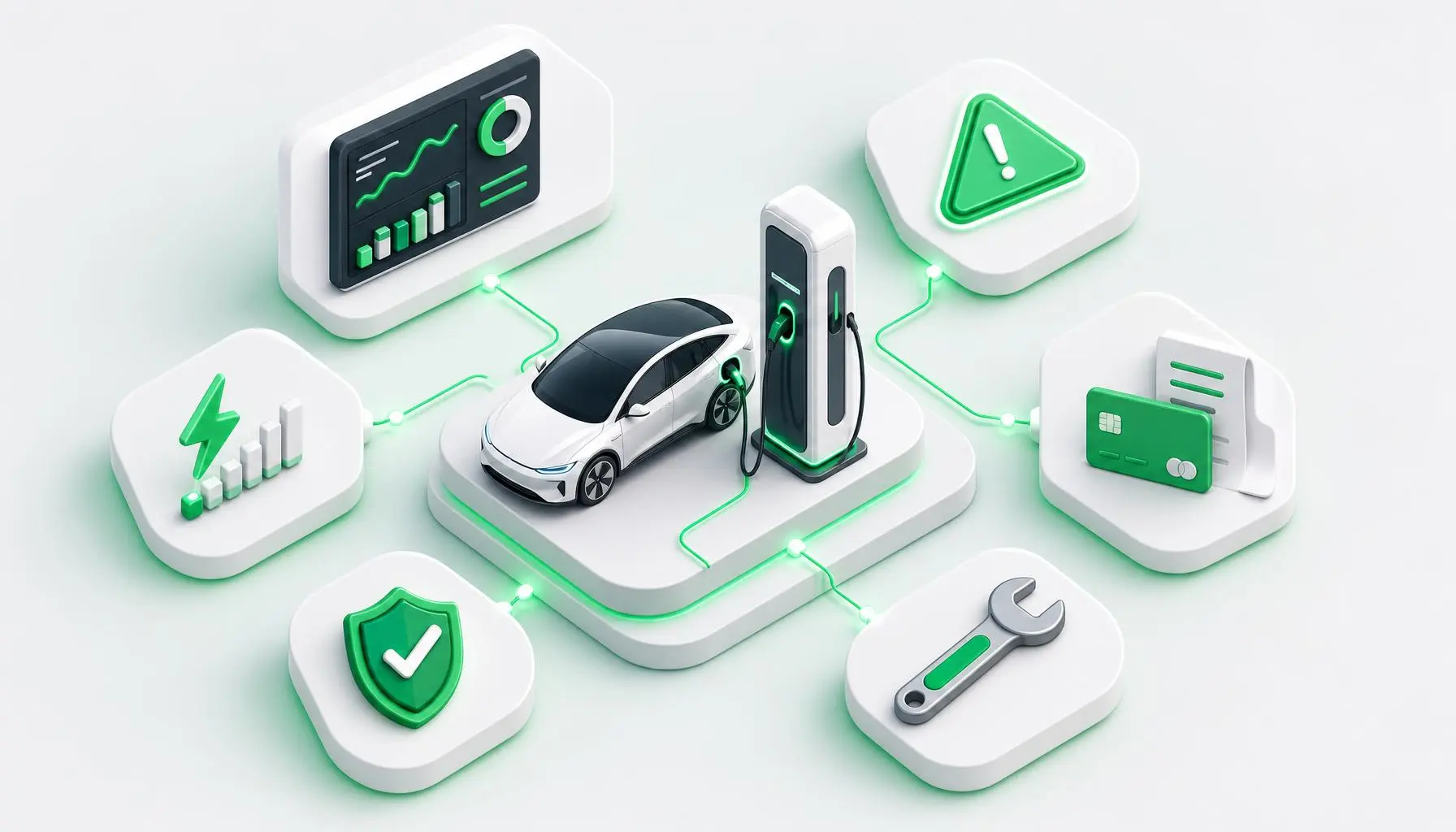
An EV charging operator becomes most visible when something stops working.
When a station is online, prices match the app, sessions start on the first try and invoices reach the customer without delay, the operator is almost invisible. But one glitch is enough to expose the whole chain: the driver cannot start a session, payment was taken but charging did not begin, the station disappears from the map, the billing document never arrives, and support does not know whether the issue sits in hardware, backend, integration or accounting.
This is where it becomes obvious whether the operator is merely a formal intermediary or the real owner of the operating process.
Operator, provider and site owner
In practice, these roles are different:
- the site owner provides the space and business conditions,
- the operator owns the customer-facing service,
- the platform provider keeps the technical stack running,
- the end user wants the problem solved.
| Area | Operator | Service / platform provider |
|---|---|---|
| Station availability | Yes, responsible for response | Indirectly, if the issue comes from the backend |
| Session start | Yes, must ensure the user flow | Yes, if the error affects the app, API or session logic |
| Billing and invoices | Yes, because it is part of the service | Yes, if the system generates documents or accounting integrations |
| Device failure | Yes, coordinates service and communication | Not directly, unless the issue comes from software |
| EIPA / AFIR / KSeF | Yes, must keep data and process in order | Yes, if the system exchanges data or documents |
What the operator does when the station is offline
Offline can mean many things:
- no backend connection,
- router or SIM failure,
- firmware issue,
- power loss,
- failed OCPP communication,
- internal station error,
- wrong configuration.
The operator should quickly check monitoring, determine whether the problem is local or platform-side, read the last heartbeat, decide whether a remote restart is possible, open the right ticket, mark the station unavailable in user channels and inform the site owner if needed.
What the operator does when a transaction does not start
This is one of the most painful scenarios because it mixes user frustration with financial risk.
Typical cases:
- payment was initiated but charging never started,
- the session started too late,
- authorization was taken but payment was not settled,
- the user was sent back to the start screen,
- the app showed success but the charger did nothing.
| Stage | What may have gone wrong | Who usually reacts |
|---|---|---|
| Authorization | card, eTag, RFID, app, token | operator and platform provider |
| Payment | payment gateway, limit, bank, preauthorization | operator, payment provider |
| Session start | start command, OCPP, connector status | operator, backend, manufacturer |
| Charging start | plug contact, wrong station state | operator, field service |
The worst mistake is to send the customer from one support channel to another without an owner of the process.
What the operator does when money does not come back
Preauthorization not released, banking delay, session marked as failed, backend confirmation missing, payment and stop logic conflicting - all of these happen in real life.
The operator should compare payment and session records, confirm the capture status, check whether a refund or cancellation happened, verify bank settlement timing, trigger a manual refund if needed, and inform the customer when the issue will be resolved.
What the operator does when an invoice never arrives
In fleet, business and home charging scenarios this is very common.
Possible reasons:
- wrong email address,
- document generation issue,
- mismatch between session and invoice,
- account misconfiguration,
- accounting integration delay,
- KSeF or other e-invoicing system failure.
The operator should verify whether the invoice was generated, sent, delivered to spam, accepted by the accounting system, whether a correction is needed, and whether the issue affects one session or the whole account.
| Scenario | Most common cause | What the operator does |
|---|---|---|
| No invoice after a session | wrong email, generator delay | checks the document, sending path and account status |
| Invoice with the wrong amount | pricing, session time, tariff change | compares the session with the tariff and triggers a correction |
| No document for a fleet | billing group problem | verifies the company account and billing rules |
| Document does not reach KSeF | integration or system status | starts diagnostics and retry flow |
What the operator does when the session is interrupted
Interrupted sessions are hard because they often combine several causes at once: vehicle stop, station error, connection drop, power limit, cable unplugged or local outage. The operator must check the cause, decide whether a refund or correction is needed, and keep the customer informed.
Why this matters
Good operator handling is not just about fixing hardware. It is about ownership of the entire customer experience: diagnosis, escalation, communication, refunds, invoices and compliance.