

Payment terminal for an EV charging station: AFIR and alternatives

Why terminals returned with AFIR
As public EV charging grows, drivers expect simple payment without an account or app installation. The experience should be closer to fueling: arrive, choose the service, pay, and charge.
AFIR, Regulation (EU) 2023/1804, strengthens that direction by requiring ad-hoc charging access at publicly accessible infrastructure.
That does not mean every charger needs a classic PIN-pad terminal.
What AFIR says about ad-hoc payments
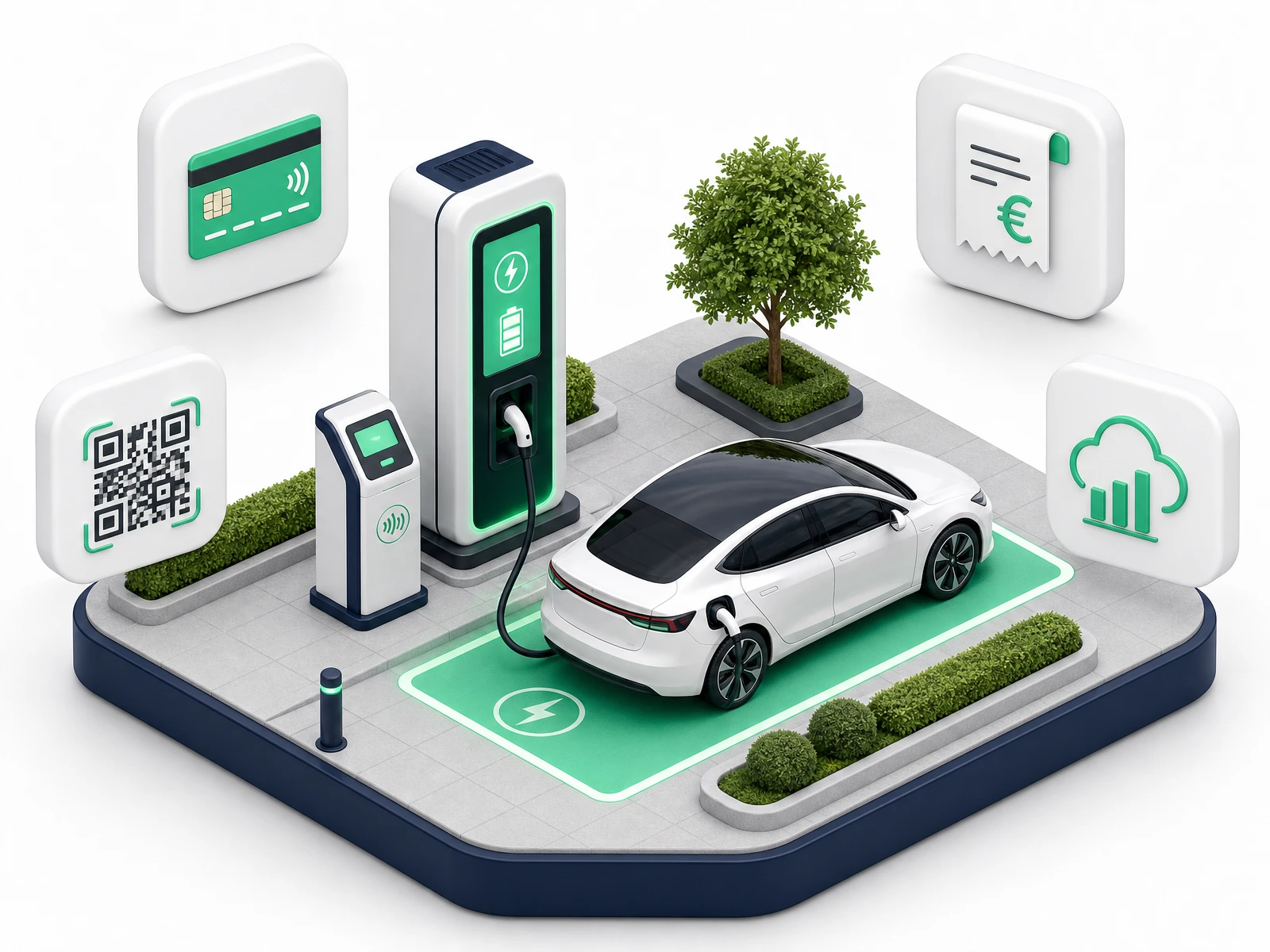
For publicly accessible charge points deployed from 13 April 2024, operators should accept widely used payment instruments through terminals or payment devices. In practice this can include card readers, contactless devices, and, for points below 50 kW, internet-connected devices enabling secure payment such as QR-based solutions.
The European Commission Q&A explains that QR-based payment can be acceptable if it leads to a secure transaction. See the Commission material on payments and alternative fuels infrastructure.
When a terminal makes sense
A payment terminal is especially justified for high-power DC stations, transit sites, route locations, public car parks, and places where the driver has no prior relationship with the site owner.
EV24® payment terminals for charging stations can be connected with the charging session billing process. The terminal activation documentation explains merchant data, device information, and billing requirements.
When QR or online payment is better
At AC stations, hotels, residential communities, offices, or private car parks, terminal cost may be too high compared with session volume. QR code, online payment, Apple Pay, Google Pay, registered access, or fleet/residential billing can be a better fit.
The EV24 web charging app lets drivers start charging without app-store installation. The Charging documentation describes payment through app, terminal, PIN, or RFID.
One terminal for many chargers
In larger locations, a terminal or kiosk can serve multiple charge points. This can reduce cost per bay, but requires clear signage and a good connector selection process.
Summary
A payment terminal is often a good solution, but not always the only or best one. AFIR requires simple ad-hoc payment, while the method should follow charger power, location type, and business model.
FAQ
Does every EV charger need a payment terminal?+
No. Requirements depend on charger type, public accessibility, power, location, and available ad hoc payment methods. Some AC scenarios can use QR or web payment instead.
What does AFIR mean for EV charging payments?+
AFIR strengthens ad hoc payment expectations at publicly accessible charging points, especially around transparent pricing and convenient payment without mandatory app registration.
When is QR payment enough?+
QR payment can be a practical solution for lower power or destination charging when it provides secure ad hoc payment and a clear driver journey.