

Charging station for a company EV fleet: employee billing

An EV fleet needs a system, not just a charger
Companies electrifying their fleet quickly learn that hardware is not enough. They need to know who charges, when, how much energy is used, and whether the session was business or private.
Without billing and reporting, questions appear: how to bill employees, control access, report energy cost, handle home charging, separate private from business use, and prepare accounting data.
Charging at the office
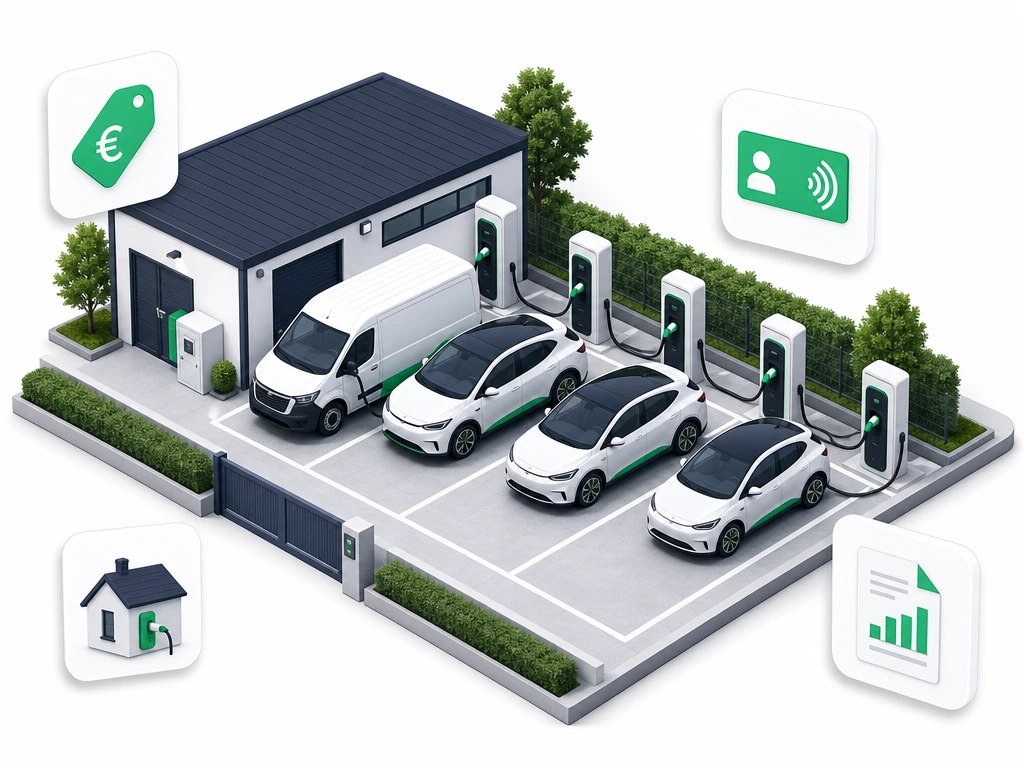
The simplest model is charging at the company site. Employees and fleet cars use workplace chargers, while the company controls energy and access. The system should support assigned users, authorization, reports per user or vehicle, access limits, history, and internal settlements.
EV24® Fleet supports this scenario. For fleets, RFID cards and PIN codes in EV24 are especially useful because they help control who starts a session.

Charging at an employee home
Many company EVs are charged at home. It is convenient, but harder for finance teams. The company needs reliable data on how much energy was used for business driving, agreed reimbursement rates, and monthly reporting.
A simple EV fleet charging policy should define where employees can charge, which sessions are business-related, when reimbursement applies, and what data is used for settlement.
Private and business charging
The system should support business charging without payment, private charging with payment, user-based reports, restricted access, and agreed settlement rules. This helps avoid accounting and tax ambiguity.
Fleet manager reports
Fleet managers need data: cost per vehicle, consumption per employee, session count, charging location, use of company chargers, and private/business charging cost. The EV24 charging station management system can support reporting and expansion decisions. For financial settlement, see EV24 Settlements.
Should a company station be public?
Some companies can make chargers public after hours or for customers. This increases utilization but requires pricing, payments, invoices, compliance, and external driver support.
Summary
A fleet charging station should be part of an EV fleet management process. EV24 helps companies organize office charging, home charging reimbursement, reporting, access control, and mixed public/private scenarios.
FAQ
How can a company settle employee EV charging?+
A company can use RFID, PIN, user accounts, vehicle assignment, session history, tariffs, and reports to assign costs to employees, vehicles, or departments.
Can fleet chargers also be public?+
Yes, but public access requires pricing, payments, invoices, compliance, support, and clear rules for separating fleet and external sessions.
What should a fleet monitor?+
A fleet should monitor energy consumption, session count, charging location, cost per vehicle, employee usage, and station availability.