

EV charging station at a hotel: how to earn from guest charging

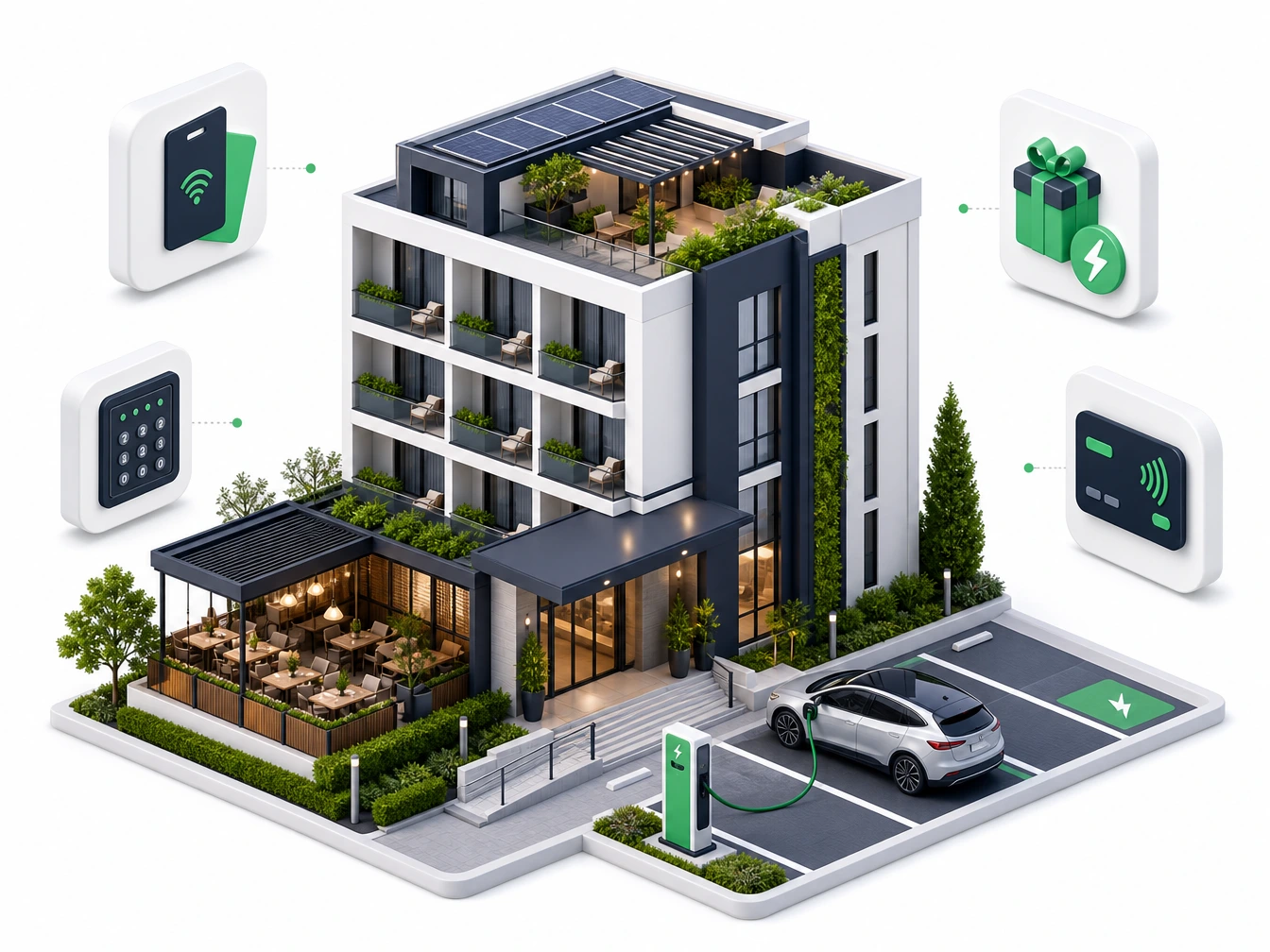
Why hotels should think about EV charging
An EV charging station at a hotel is no longer a small extra for a few guests. It increasingly influences booking decisions, especially for business travelers, families on longer trips, and drivers planning a route with overnight charging.
For a hotel, a charger can work in three ways:
- as an amenity for overnight guests,
- as a paid service for restaurant, spa, or conference customers,
- as a publicly available charge point that brings additional traffic.
The key is to avoid creating manual work for reception. If a guest has to ask about access, price, invoice, cable, or payment, the service quickly becomes operationally expensive.
The common mistake: free charging without control
Many hotels start with free charging for guests. It works at first, but scales poorly when more EVs arrive, external users start charging, drivers block bays after charging, and energy cost becomes visible.
Free charging can still be part of a premium package, but it should be controlled. The hotel needs to know who charged, how much energy was used, and whether the cost belongs to the stay, the hotel, or the driver.
Billing models for hotels
A hotel can use several models:
- Paid charging per kWh for all users.
- Free charging for hotel guests and paid charging for external drivers.
- Charging included in a selected stay package.
- Discounted charging for conference or restaurant customers.
- Public charging with pricing visible in the app or after scanning a QR code.
The most practical model is usually mixed. The hotel can reward guests while keeping control over cost and infrastructure utilization.

How EV24 simplifies hotel charging
EV24 lets hotels operate charging as a normal service instead of a manual exception. A manager can use charging station management software to set prices, monitor sessions, and bill users.
In practice, the hotel gets automated payments, charging without app installation, invoices, session history, station status, access control, and multiple pricing models.
For drivers who do not want to install an app, the hotel can use the EV24 web charging app or QR codes. In locations with higher traffic, payment terminals for EV charging stations may also make sense.
The EV24 documentation for charger configuration is useful during rollout because it shows that beyond OCPP, the operator must configure tariffs, authorization methods, address, QR code, and country requirements.
Hotel scenarios worth separating
Hotels should not treat all drivers the same. An overnight guest, conference attendee, restaurant customer, and external driver have different expectations and billing logic.
A well-configured system can separate guest charging included in a stay, paid charging for restaurant customers, event access, public charging outside peak occupancy, and reports for accounting.
AC or DC at a hotel
AC usually works best at hotels because cars stay for several hours or overnight. It is cheaper to buy, easier to install, and sufficient for most guests.
DC makes sense when the hotel is near a route, has high restaurant turnover, runs conferences, or wants to attract external drivers for shorter stops.
Before choosing hardware, review the criteria in how to choose an EV charging station. If the hotel wants to use PIN or RFID for selected groups, the Access Tokens documentation explains RFID and PIN authorization.
How to communicate the service to guests
The charger should be visible in booking information, parking descriptions, pre-arrival messages, and guest materials. Drivers need to know where the charger is, what connector and power it has, how much charging costs, whether external users can use it, how to start a session, and how to get an invoice.
Summary
An EV charging station can increase hotel attractiveness and generate additional revenue, but only if it is easy to use and properly billed. EV24 helps hotels launch charging without manual session settlement at reception.
FAQ
Is an EV charging station profitable for a hotel?+
It can be profitable when guests actually use it and the hotel controls tariffs, payments, access, and reporting. It can also improve booking attractiveness even when direct charging revenue is moderate.
Should a hotel choose AC or DC chargers?+
Most hotels start with AC chargers because guests often park overnight. DC may make sense for route hotels, conference venues, or locations with short stay traffic.
How can a hotel bill guests for charging?+
A hotel can use QR payments, app payments, payment terminals, room account processes, access codes, or separate invoices depending on its operating model.