
EV chargers in a housing community: approvals, access, and billing

Why housing communities increasingly face EV charging
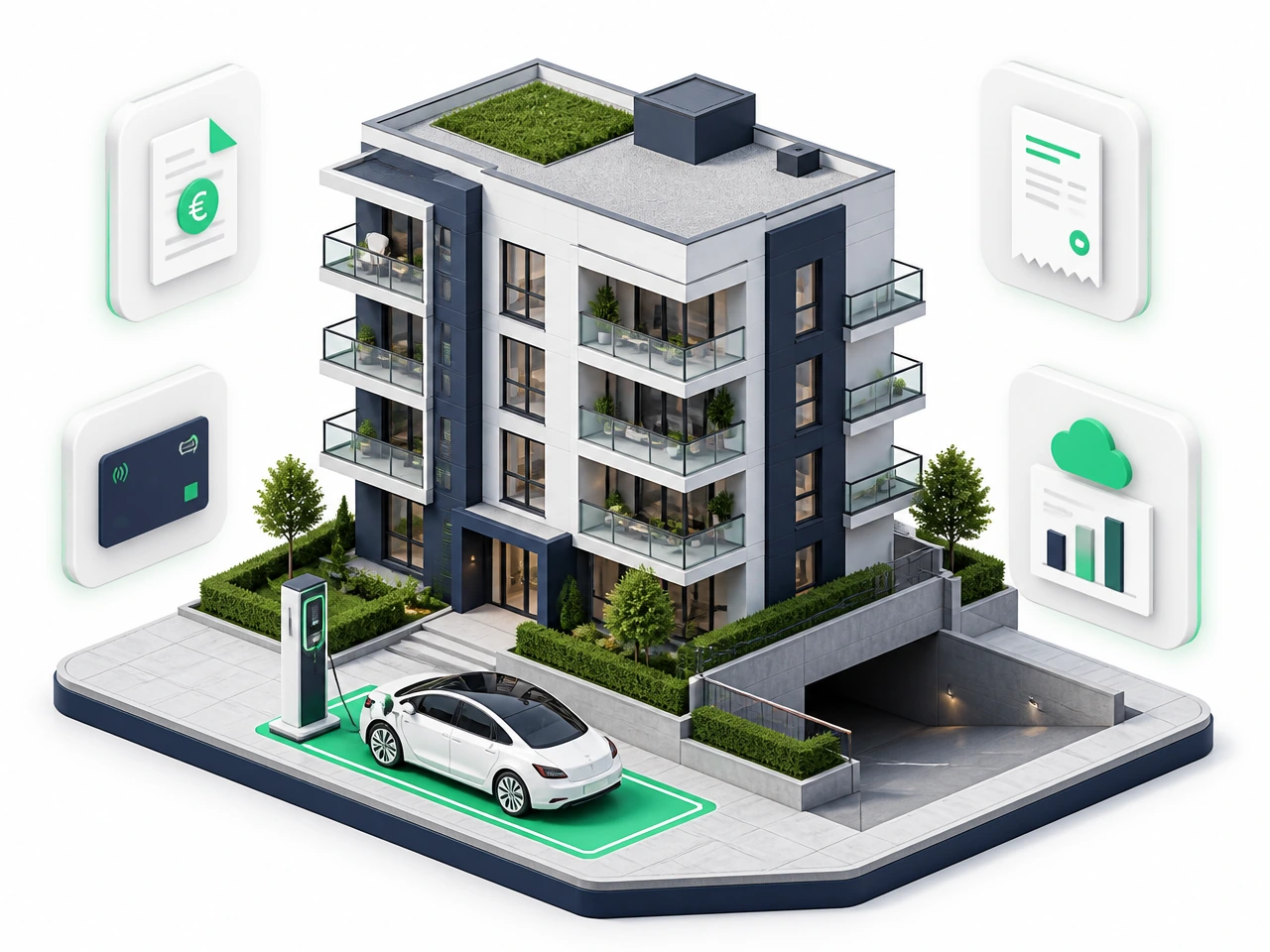
EV charging in underground garages and residential car parks is becoming a regular topic for boards and property managers. Residents want to charge where they park overnight, while the community has to manage safety, access rules, and energy billing.
This is not only a technical issue. The manager must consider approvals, electrical assessment, cost allocation, user accountability, access control, and infrastructure responsibility.
Private charger or shared infrastructure
A community usually sees two scenarios: a resident requests a private charger at an assigned parking space, or the community builds shared infrastructure for more residents.
The first model looks simple, but after several individual installations it creates scale problems. Each point has separate rules, protections, and billing. Shared infrastructure requires more planning, but gives the community more control.

What to decide before rollout
Before launching chargers, answer key questions: who can charge, whether charging is only for residents, whether the tariff is per kWh, time, or subscription, how shared energy is billed, who handles service and monitoring, and what happens when a car blocks a space after charging.
Resident billing is the key element
The biggest mistake is connecting a charger to shared building power without precise billing. Then the cost can fall on all residents, including those without EVs.
EV24® for housing communities helps organize access, user history, session records, and billing. Property managers avoid spreadsheets and residents get a clearer process.
On top of that, EV24 is fully integrated with MyTower, the property management system. Charging and billing run inside the same process the manager already uses every day — with no rekeying of data between systems.
Access control: who can charge
Residential charging should usually be restricted. EV24 can use assigned users, PIN, RFID, or other access methods so every session has an owner.
The Access Tokens documentation explains RFID and PIN authorization. The charger configuration documentation also helps organize tariffs, authorization methods, address, QR code, and country requirements.
Legal and safety context
In Poland, charger installation in multi-family buildings is increasingly discussed by lawyers and real-estate experts. A 2025 case concerning consent for a charge point at a private parking place was described by Rzeczpospolita. A useful technical supplement is the CBRE article on charger installation conditions.
Summary
EV chargers in housing communities should be treated as managed infrastructure, not individual sockets for selected residents. EV24 helps communities manage users, access, session records, reports, and billing.
FAQ
Can a housing community control who uses EV chargers?+
Yes. Access can be limited to residents or selected users through RFID, PIN, user accounts, or other authorization methods.
How are charging costs settled in a residential community?+
Costs can be assigned to users based on session data, energy consumption, tariffs, and reports from the management system.
Does a residential charger need to be public?+
No. Many residential chargers work as private or semi private infrastructure with controlled access for residents.