
5 mistakes when choosing an EV charging operator that cost property owners thousands a year

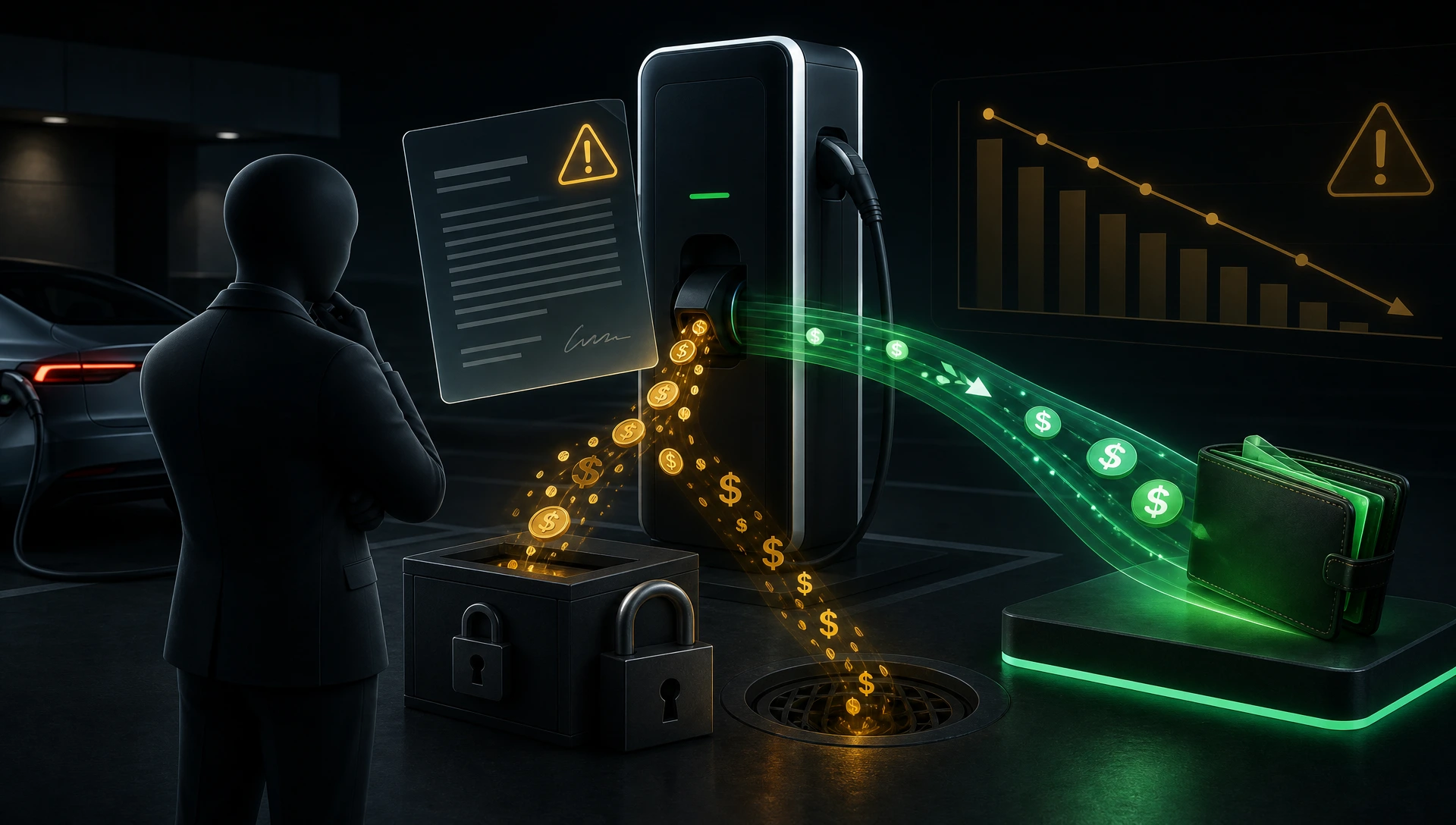
The charging station stands in the car park, lit up, charging cars — and yet, instead of earning, it mostly generates costs and frustration. The property owner does not know how much the sessions really bring in, someone else sets the prices, invoices arrive late, and the money — if at all — lands in the account only months later and after re-invoicing. Sound familiar? In most cases the source of the problem is neither the hardware nor the location, but the choice of EV charging operator.
It is a decision for years. The operator (or the charging-service and platform provider) decides who sets prices, where the money goes, what data you get, how much operations cost you, and whether you can later change anything without replacing the whole infrastructure. And yet most property owners make this choice "by gut feeling" — comparing the purchase price of a charger rather than the terms of cooperation that will decide revenue for years to come.
In this article we go through the 5 most common mistakes when choosing an EV charging operator that genuinely cost property owners thousands a year — in lost revenue, in time and in penalties. For each we show what it costs, how to recognize it and how to choose well. At the end you will find a checklist of questions to ask every provider.
Why the choice of operator is worth thousands
Before the mistakes — why is this decision so costly? Because the operator controls four things that together decide the station's profitability:
- Revenue — who sets prices, how fast and where the money goes, what the commission is.
- Costs — whether the station stays within the connection capacity, whether energy is bought smartly, how much time operations eat.
- Data — whether you see what happens at the station and can make decisions.
- Flexibility — whether you can change provider, add stations of another brand, grow.
A mistake in any of these areas does not hurt once — it hurts every month, for the whole cooperation period. And that is exactly why seemingly small differences in the operator's model add up to thousands a year.
Why these mistakes are so easy to make
If the mistakes are so costly, why do so many property owners make them? For a few reasons worth being aware of before you sit down with a provider.
First, we compare the wrong things. At the decision stage it is easy to focus on the charger's purchase price and power — because those are simple numbers to line up. The cooperation model with the operator is harder to compare, so it gets skipped, even though it decides revenue for years.
Second, convenience tempts. An offer of "we'll handle everything, you don't have to do a thing" sounds attractive, especially to an owner for whom charging is a side activity. The catch is that "you don't have to do anything" very often means "you control nothing" — and those are two different things.
Third, costs are spread out and invisible. None of the five mistakes issues one big invoice. The leak happens bit by bit — lower margin here, a frozen payment there, an hour of accounting every month — so it is hard to notice without deliberately looking at the whole.
Fourth, the market is young. Many providers and many owners are learning in practice, and standards are only settling. That is good news: an aware owner who asks the right questions is in a far better negotiating position today than a few years ago.
Awareness of these mechanisms is half the battle. The other half is knowing what exactly to look at — and that is what we do now, mistake by mistake.
Mistake 1 — No transparency and no access to data
The most common and most insidious mistake: choosing an operator that does not give you full, live insight into what happens at your station. How many sessions were there? How much energy was dispensed? What is the revenue and what is the energy cost? Which hours are the most profitable? If the answer is "the operator will send a monthly PDF statement" or "you have to email and wait" — that is a mistake.
Why it hurts. Without real-time data you fly blind. You do not know whether the price is right, whether the station pays off, or whether there is a fault that has been cutting revenue for a week. You also have no way to verify the operator's settlements — you have to take their word. And where there is no transparency, the side with less data almost always loses — that is, you.
What it costs. An undetected connector fault means weeks of zero revenue from one bay. Not knowing the traffic profile means mis-set prices and untapped potential. Over a year — easily several thousand of lost revenue per station.
How to avoid it. Choose an operator with a portal where at any moment you see sessions, energy, revenue, costs and station statuses — ideally the same view for a single station and for the whole network. Full insight is not a luxury, it is a condition for making any decisions at all. We expand on this in the piece on managing a network of charging stations — where we show what an operation based on data, not on a monthly PDF, looks like.
Mistake 2 — Handing over control of pricing
The second mistake is signing a contract in which the operator sets the charging prices and you have no real influence on them. At first glance convenient ("I don't have to deal with it"); in practice — costly.
Why it hurts. The operator's energy cost changes hour by hour, and the charging market is in motion. If you do not control the price, you cannot react: neither raise the rate when energy is expensive (margin vanishes), nor lower it when energy is cheap and you want to attract traffic. Nor will you differentiate the price for different groups — one tariff for hotel guests, another for employees, another for street traffic. The tariff is the main tool for steering the station's business — and you are giving it away.
What it costs. An averaged, flat price means either selling below the line at peak or giving away potential volume in the valley. Owners who switched to dynamic pricing usually protect margin and increase station utilization at the same time — the difference runs into thousands a year per location.
How to avoid it. Make sure that in the operator's model you define the tariffs and commissions — per kWh, per time, a start fee, an idle fee, different rates for different groups. Check whether the platform supports prices that depend on time of day and energy cost. Control over price must stay on your side.
Mistake 3 — Manual invoicing and billing
The third mistake tends to be invisible until the first month-end close: choosing an operator where invoices, fiscalization and billing happen manually. Someone collects session data, copies it into a spreadsheet, issues documents, watches the taxes, corrects errors.
Why it hurts. The biggest operating cost of a station is often not energy but financial handling. Manual billing means hours of accounting work every month, the risk of errors, late invoices and complaints. With one station you can survive it; with several locations the manual process becomes a millstone that blocks growth.
What it costs. Several to a dozen hours of work a month on handling, plus the cost of errors and corrections. Over a year that is a real, recurring expense that a good platform reduces to almost zero.
How to avoid it. Demand automation: invoices, fiscalization / e-invoicing, billing and notifications should happen by themselves, with no manual steps on your side, and be compliant with AFIR and local regulations. We describe what an accountable, automatic billing process should look like in the piece on charging station billing.
Mistake 4 — Revenue via re-invoicing instead of straight to your account
This is the mistake that hurts the most and is least understood at the point of signing. In many models the money from drivers lands first in the operator's account, and you get your share later — after re-invoicing, after the billing period closes, after the commission is deducted.
Why it hurts. First — liquidity. Your revenue "freezes" at the operator's for weeks or months instead of working for you. Second — counterparty risk. If the operator has problems, your money is on their side. Third — transparency. With re-invoicing it is hard to verify whether the amount is complete and the deductions add up — back to mistake number 1. Fourth — hidden commissions, which are easier to "bury" in a re-invoice than in a direct transfer.
What it costs. The loss of liquidity alone is the cost of money over time; at higher volume — noticeable. On top come commissions, which in a re-invoicing model tend to be higher and less visible, and a risk you cannot price until it materializes.
How to avoid it. Look for a model in which payments from drivers land directly in your payment account, not an intermediary's. This is a fundamental difference: you have full control over revenue, margin and liquidity from day one. Such a direct-revenue model is one of the pillars of the white label approach, where you own the customer relationship and the money, rather than merely receiving a re-invoice.
Mistake 5 — A model that quietly kills revenue
The fifth mistake is choosing an operator whose technology and commercial model eats your margin — often in a way you only see over time. It is made up of several things:
- Vendor lock-in. If the platform does not support the open OCPP protocol, you are tied to one hardware brand and one provider. You cannot add a cheaper charger from another manufacturer or change operator without replacing the infrastructure. A lack of competition always costs.
- No power management. Without load balancing, stations can exceed the connection capacity — which means paying penalty distribution fees or an expensive connection upgrade. A good operator protects you from this in software.
- No revenue optimization. Without dynamic pricing and data for decisions, the station earns whatever "comes out" instead of what it could.
- Hidden and high commissions. A model with a high or opaque commission quietly lowers every session.
Why it hurts. This is the "quiet leak" mistake — individually each element looks harmless, but together they make the station generate a fraction of what it could, and it cannot be fixed easily without changing the whole setup.
What it costs. Penalties for exceeding capacity, over-ordered capacity paid every month, lower margin from a lack of optimization, and commissions — together usually the fattest item of the whole five.
How to avoid it. Choose an operator built on an open standard (OCPP), with built-in power management, dynamic pricing and a transparent commission. Ask outright about the ability to add another brand's hardware and about the terms of exiting the contract — the answer will tell you more than the entire marketing pitch. A good starting point is also the right hardware selection for an open ecosystem.
What it really costs: an example on one location
The numbers depend on scale, but it is worth seeing how small items add up over a year. Take a typical commercial location: 4 AC points in an office car park, moderate traffic. Below is an indicative, illustrative picture of how much each of the five mistakes can cost per year — not an exact quote, but the scale of the phenomenon.
| Mistake | Source of cost | Order of magnitude / year |
|---|---|---|
| No transparency | undetected faults, bad pricing decisions | lost revenue from downtime |
| No price control | selling below the line at peak, no volume in the valley | margin eroding on every session |
| Manual billing | accounting hours + corrections | a recurring handling cost every month |
| Revenue via re-invoicing | frozen liquidity, hidden commissions | cost of money over time + higher commission |
| A model that kills margin | capacity-overshoot penalties, no optimization, lock-in | usually the fattest item of the five |
None of these costs hurts once — they all come back every month. That is exactly why the sum of five mistakes on a single location easily reaches thousands a year, and across several locations it multiplies linearly. Conversely: a good choice of operator does not so much "save" as it releases revenue that was within reach all along — it was just leaking.
What to look at in the operator contract
The cooperation model shows not in the sales deck but in the contract clauses. Before you sign, check especially these points — this is where costs and constraints are most often hidden:
- Data ownership. Do the data on sessions, customers and revenue belong to you, and will you take them with you when changing provider? If the data "stays with the operator", you lose your most important asset.
- Exclusivity and term. Does the contract not bind you for years with an exclusivity that blocks adding another brand's hardware or negotiating with the competition.
- Commission structure and indexation. Is the commission single and transparent, or rather split into several items that together add up to more than it seems — and can the operator raise it unilaterally.
- Exit terms. Can you terminate the contract without losing infrastructure and data, within a reasonable period and without prohibitive penalties.
- Service SLA. Who is responsible for faults, with what response time, and does a station outage reduce your obligations toward the operator.
- Compliance and liability. Who is responsible for AFIR compliance, fiscalization and data protection — and what happens when the rules change.
A healthy operator does not fear these questions — on the contrary, it raises them itself. If you meet generalities or pressure to sign quickly, that is the best reason to slow down and compare offers calmly. It also helps to look at the white label model, where ownership of the brand, data and revenue is on your side by design.
Checklist: how to choose an operator well
Before you sign a contract, ask every provider these questions — including the competition. A good operator will answer "yes" to all of them without hesitation:
- Can I see full data on sessions, energy, revenue and costs in a portal at any time?
- Do I set the tariff and commissions, and can I differentiate prices and apply dynamic pricing?
- Are invoices, fiscalization and billing fully automatic and AFIR-compliant?
- Do payments from drivers land directly in my account, not via re-invoicing?
- Is the commission transparent and predictable — and what exactly does it cover?
- Does the platform support OCPP and multi-vendor hardware (no vendor lock-in)?
- Is power management (load balancing) included, protecting against penalties for exceeding the connection?
- What are the exit terms and do I keep my data and the customer relationship?
- Who is responsible for service, monitoring and tickets and with what response time?
- Does the model scale with the network as I add more locations?
Treat this list as a cheat sheet for the conversation. If a provider avoids answering questions 1, 4 or 6 — that is the clearest signal to keep looking.
Summary
Choosing an EV charging operator is not a hardware purchase but a decision about who controls your revenue, costs and data for years to come. The five most costly mistakes are: no transparency, handing over price control, manual billing, revenue via re-invoicing instead of straight to your account, and a model that quietly eats your margin.
The common denominator of a good choice is simple: transparency, control over price, money directly in your account, automatic billing and an open, revenue-optimizing model. If the operator gives you all this, the station works for you. If not, you work for the operator — often without realizing it until the first annual summary.
FAQ
What are the most common mistakes when choosing an EV charging operator?+
The five most costly are: no transparency and no access to data, handing the operator control of pricing, manual invoicing and billing, revenue reaching you only after re invoicing instead of directly in your account, and a technology and commercial model that quietly eats your margin (vendor lock in, no load balancing, hidden commissions).
Why should revenue land directly in my account?+
Because in a re invoicing model your money freezes at the operator's for weeks or months, you lose liquidity, you carry counterparty risk, and it is harder to verify that the amount and deductions add up. Payments directly to your payment account give full control over revenue and margin from day one.
Should I control charging prices or leave it to the operator?+
Control over the tariff should stay on your side. Price is the main tool for steering the station's business — it lets you react to energy cost, differentiate rates for different groups and apply dynamic pricing. Handing it to the operator usually means an eroding margin.
What is vendor lock in and why is it costly?+
It is dependence on a single provider when the platform does not support the open OCPP protocol. You then cannot add another brand's hardware or change operator without replacing the infrastructure. A lack of competition means higher costs and a weaker negotiating position.
How can I tell whether an operator is transparent?+
Ask for access to a portal where you see sessions, energy, revenue, costs and station statuses in real time — for a single location and for the whole network. If the only form of reporting is a monthly PDF "on request", transparency is missing.
Do these mistakes apply to small sites with one station too?+
Yes. With one station some costs (e.g. manual billing) hurt less, but a lack of price control, revenue re invoicing and vendor lock in cost regardless of scale — and with one station it is harder to "dilute" those losses. A good choice of operator pays off from the very first point.