
White label in EV charging: when it pays off, when it doesn't, and for whom

White label in EV charging: your own brand without building a system from scratch
Imagine that on Monday the decision is made: "we're entering EV charging under our own brand." In the classic scenario, a months-long IT project begins — a development team, a mobile app, station integrations, a payment gateway, invoices, regulatory compliance. In the white-label model, that same Monday can end with a working platform branded with your logo, ready to accept its first driver.
That is the whole difference. White label lets you launch your own EV charging network and brand without building the technology from scratch. You take on the brand, the locations and the customer relationship, while the platform provider delivers and maintains the rest: the driver app, the charge point management system, payments, billing and compliance.
It sounds like the perfect shortcut — but it is not for everyone. In this article we explain plainly: what exactly white label is, which features it covers, when it truly pays off, when to skip it, and who it is the best choice for. At the end you will find a checklist for a conversation with any provider.
In short: white label usually makes sense when your edge is meant to be the brand, the locations and customer service — not proprietary software. Below we explain how to approach the topic, what to watch for, and when it is better to build your own system. As a reference point, we show how such a model works with us — on the EV24® White Label platform.
What white label in EV charging is
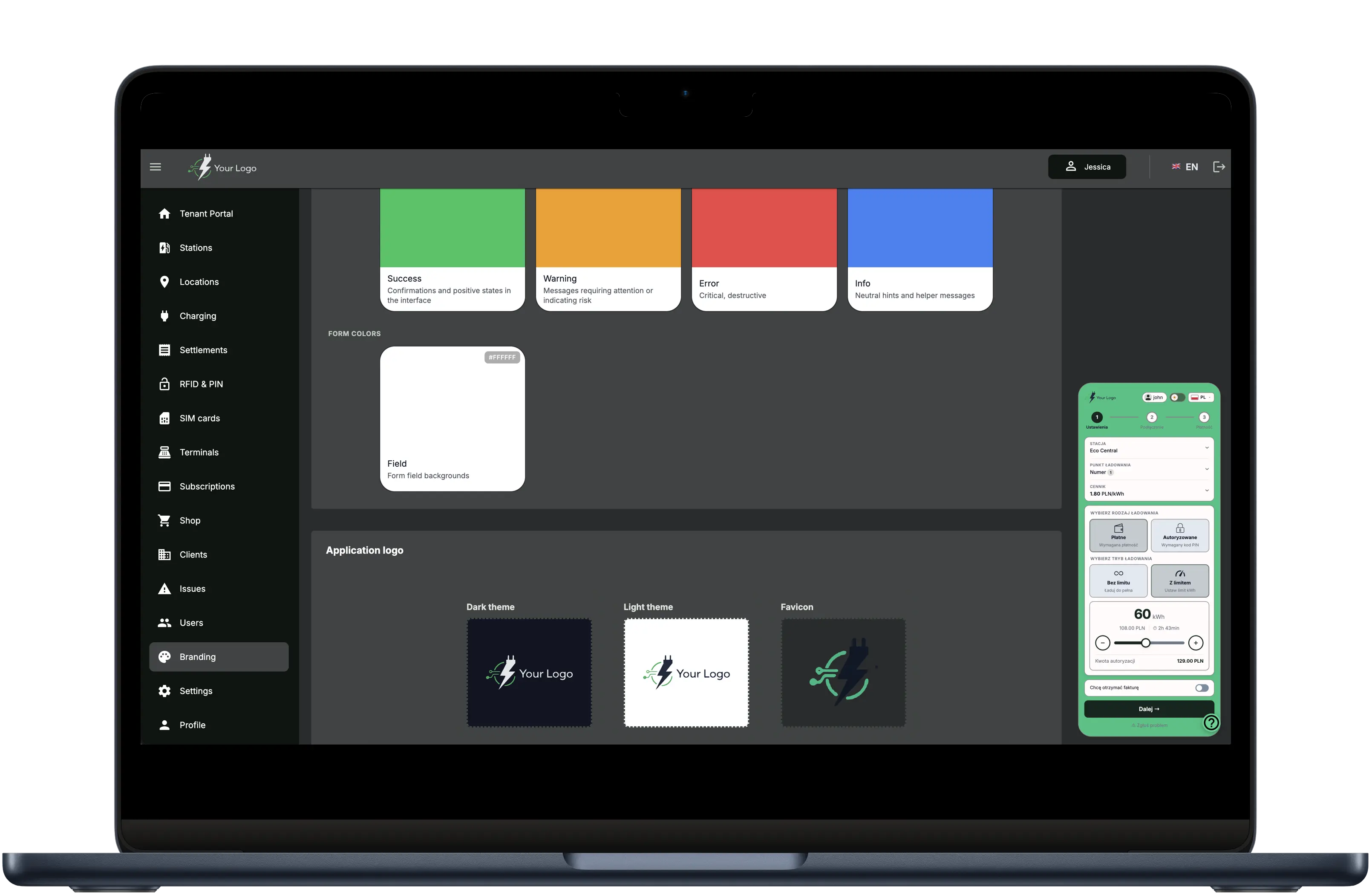
White label is not a "template" or a single app. It is a complete ecosystem operating under your brand and domain — from the app, through the portal, to documents and payments. The end customer sees only your brand; the technology stays "under the hood".
Which features white label covers
This is the most often overlooked yet most important part of the decision. "Own brand" is not just a logo — it is a concrete set of working features. Here is what you really get.
Brand and branding at every customer touchpoint
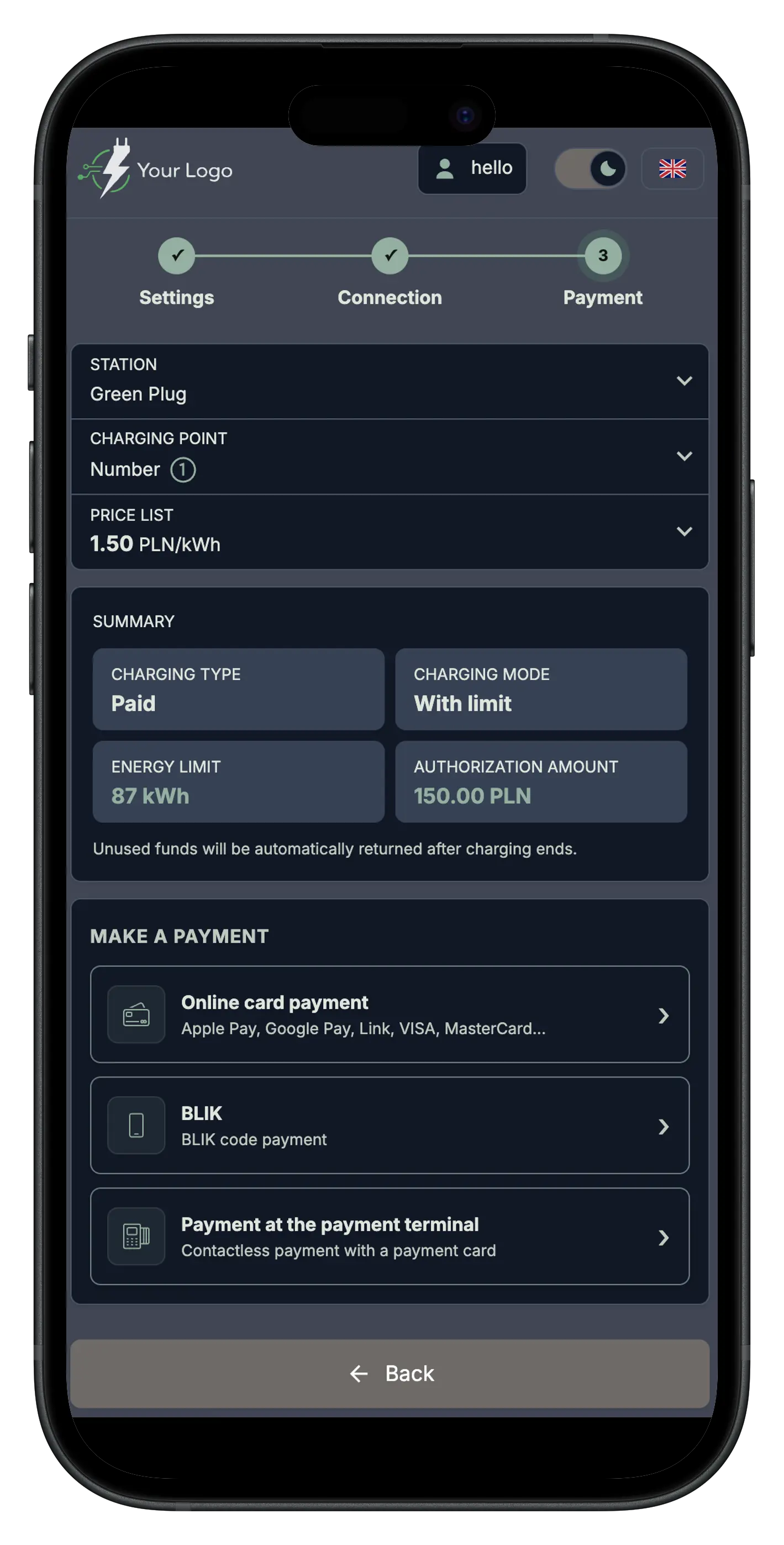
Branding does not end with the app. It covers the logo, name and color scheme of the driver app, but also sales documents, invoices and billing statements, content shown on payment terminals, email messages and notifications, and QR codes, stickers and instructions at the stations. From the first contact — the map, the charger screen, the payment confirmation, the invoice — the driver sees your brand consistently.
Driver app
A ready mobile app under your brand: station search and map, session start and stop, payment, charging history and invoices, authorization by RFID card or PIN. The driver does not have to install a "foreign" app or create an account with an intermediary — they operate in your ecosystem and your domain.
Operator portal
Brand is one thing, but the daily work happens in the portal. This is where you set prices, monitor stations, manage customers and locations, handle tickets and pull reports — without logging into each charger separately.
Tariffs, commissions and revenue
You define your own subscription tariffs and individual commissions — per kWh, idle time, session, as well as fees from the owners of stations in your network. Importantly, payments go to your payment account, not an intermediary's. You have full control over revenue, margin and pricing policy for different customer groups.
Billing and compliance
Invoices, fiscalization, billing and notifications happen automatically — with no manual steps on your side. The platform also handles AFIR requirements: a clear price before the session and ad-hoc payment, as well as data protection. More on the process itself in the piece on charging station billing.
Terminals, SIM cards, shop and partners
In a fuller scope come payment terminals (card and contactless payment, per AFIR), SIM cards for station connectivity, a shop for customers, and a partners module — useful when you build a network together with location owners.
AI VoiceBot and support
An AI VoiceBot handles drivers and tickets 24/7 — it answers the phone, helps start a session, answers common questions — taking load off your team. Infrastructure maintenance, monitoring and ticket handling are on the provider's side.
API and integrations
An open API lets you connect the network to your systems — CRM, ERP, data warehouse or your own apps — and automate flows without manually re-entering data.
Packages: Standard and Premium
The scope usually splits into two packages. Standard is the foundation of your own brand, Premium adds sales and operational tools.
In Standard you will find, among others: branding of the app, documents, billing, emails and terminals; your own domain for the app and a subdomain for the portal; your own tariffs and commissions; your own terms for customers and drivers; branding of QR codes, stickers and instructions; ticket handling and infrastructure maintenance on the provider's side.
In Premium you additionally get: a shop for customers, a partners module, SIM cards, payment terminals and an AI VoiceBot. This distinction makes budgeting easier — you start with what you truly need and enable further modules as the network grows.
Pay-as-you-go model: you pay for scale
Instead of a large upfront investment, cost scales with the number of charging points. The larger the network, the lower the unit cost — exact rates are set in the contract. The thresholds grow with you:
When white label pays off
White label works when you care about a fast market entry and focusing on the business rather than maintaining software. The most common situations:
- You want to start almost immediately. Instead of months of development, you configure the brand, domain, tariffs and products — the first station can accept drivers the same day.
- You have a limited budget and don't want an IT team. You don't pay for servers, an app or developers; the entry cost is low, and billing grows with the network.
- You need payments and compliance "out of the box". Invoices, fiscalization, billing and AFIR work automatically.
- You build a brand, not technology. The app, terminals and QR codes work in your colors from day one.
When white label is not for you
Honesty builds trust, so let's say it plainly — there are situations where your own system or a different cooperation model will be better:
- You have your own development team, budget and time and want full control over the code, roadmap and technology ownership.
- Your requirements are highly unusual — proprietary protocols, exotic integrations, processes beyond the market standard.
- You are a large operator with a polished, working system, and migration would not bring enough benefit.
White label vs building your own system
Briefly, what really separates the two approaches:
- White label — launch in days, low upfront cost (pay-as-you-go), no IT team, maintenance and updates on the provider's side, built-in compliance (AFIR, invoices, fiscalization). In return: limited control over the code.
- Building your own system — full control over code and roadmap, but months to years to launch, high cost (team, infrastructure), compliance and maintenance entirely on your side.
In practice the choice comes down to a question: do you want to be a technology company or a charging network operator. For most entrants to this market, time to launch, predictable cost and ready compliance matter more — and that most often tips the scales toward white label. If the technology is meant to be your own product, building your own system can be justified.
Who white label is for
The model is most often chosen by:
- investors building a charging network as a source of revenue,
- operators (CPOs) and location-management companies — see charging point operators,
- hotels and rentals and HoReCa venues — see an EV charging station at a hotel,
- communities and developers — more in the piece on chargers in a housing community,
- dealers, installers and energy suppliers who want to offer charging under their own brand,
- companies with a fleet — see a fleet charging station.
What to watch for when choosing a platform
Before you sign a contract, check whether the provider offers:
- your own brand, domain and app for drivers, plus an operator portal,
- your own tariffs and commissions and payments to your payment account,
- OCPP compliance and support for multi-vendor hardware (no lock-in to a single supplier),
- automation of invoices, fiscalization and billing, and compliance with national and EU regulations (AFIR, data protection),
- an API for integration with your systems,
- a pay-as-you-go model that scales cost with the number of points,
- support and maintenance of the infrastructure on the provider's side.
Treat this list as a cheat sheet for a conversation with any provider — including the competition.
Summary
White label lets you enter the market under your own brand faster and at lower cost — provided your edge is meant to be the business, not proprietary software. Do you have your own team and want full control over the code? Then it is worth costing out building your own system. In all other cases, a ready platform lets you start in a few days, with ready features, payments and compliance, and the cost grows with the network. The main thing is to compare both options deliberately on your own numbers.
If you want to see what such a feature set looks like in practice, we describe it as a reference point on the EV24 White Label platform, and you will find indicative costs in the pricing.